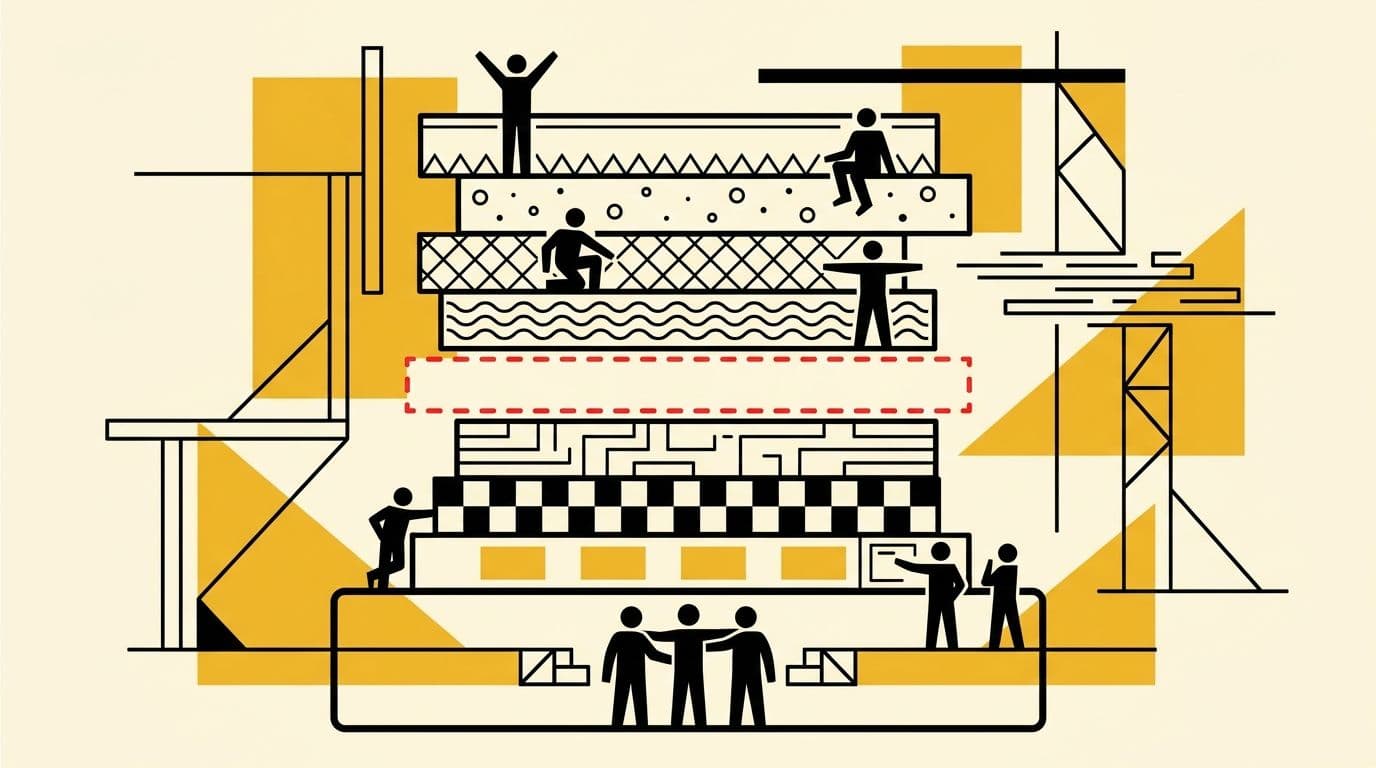
TL;DR. “Full stack” is a property of a team, not a person: assign end-to-end ownership of the nine engineering surfaces to a small group and let specialists appear only where the maturity ladder says they must (data, DevOps, QA, security). One strong full-stack developer is right for early stages; a 3–5 seat pod with explicit ownership, a vetting process that tests team behaviour not trivia, and a 90-day onboarding roadmap is what holds at scale. Remote changes the communication design, not the structure. Companion piece: the distributed technology team blueprint covers the support, IoT and AI/ML layers around the build layer.
What is the right full-stack development team structure?
A full-stack development team structure assigns end-to-end ownership of nine engineering surfaces — interface, application logic, API contract, data, identity, infrastructure, delivery pipeline, observability and security — to a small, named group of engineers. The correct structure is the smallest team that leaves no surface uncovered at your current product stage.
- CTOs and VPs of Engineering designing or repairing a team structure
- Technical founders deciding between one generalist, a pair, or a pod
- Engineering managers and Heads of Product mapping ownership across the stack
- IT directors and procurement leads evaluating team-based engagement models
That is the short answer. The rest of this guide is the long one, because the short answer hides the decision that actually breaks teams: which surfaces a generalist can hold, which ones demand a specialist, and how the answer changes as a product moves from prototype to regulated production system.
This guide is written for the people who have to sign off on the org chart — CTOs, VPs of Engineering, technical founders, Heads of Product and procurement leads — and it is deliberately structural. It does not quote rates. Where cost matters, it links to the pages that own that data.
Why "full stack" is a property of teams, not of people
The phrase "full-stack developer" describes a person who can move between the browser and the database without waiting for a handoff. It is a real and valuable capability. It is also, on its own, a poor unit of organisational design, for three reasons that show up in almost every failing team we are asked to repair.
First, official occupational taxonomies do not recognise it as a distinct occupation. The US Bureau of Labor Statistics classifies the relevant work under Software Developers, Quality Assurance Analysts, and Testers and separately under Web Developers and Digital Designers; its published definitions describe software developers as people who "design computer applications or programs" and QA analysts and testers as people who "identify problems with applications or programs and report defects" (BLS Occupational Outlook Handbook, Computer and Information Technology Occupations). Web developers are separately defined as people who "create and maintain websites," with digital designers covering "website or interface layout, functions, and navigation for usability" (BLS, Web Developers and Digital Designers). No official category maps cleanly to "full stack." That means the title carries whatever meaning the hiring company gives it — which is exactly why two companies can hire the same title and get incompatible outcomes.
Second, the surface area has grown faster than any individual's practice time. A team shipping a modern web product in 2026 is expected to hold typed JavaScript, a component framework, a server runtime, a relational database, containerisation, a cloud provider, a CI/CD pipeline, an observability stack and a security posture. The Stack Overflow 2025 Developer Survey shows how wide the professional baseline has become: among professional developers, 68.8% used JavaScript, 63.0% HTML/CSS, 61.3% SQL, 54.8% Python, 48.8% Bash/Shell and 48.8% TypeScript in the past year (Stack Overflow 2025 Developer Survey — Technology). Breadth is now table stakes; depth is the scarce commodity.
Third, coverage gaps are invisible until they are expensive. A missing owner for the delivery pipeline does not show up in a sprint review. It shows up as a Friday-night rollback. A missing owner for access control does not show up in a demo. It shows up in a penetration test — and access control is still the single most prevalent class of application vulnerability, sitting at #1 in the OWASP Top 10:2025, where on average 3.73% of tested applications had one or more of the 40 mapped weaknesses in that category.
So the working definition used throughout this guide is deliberately narrow:
What does "full stack" actually cover in 2026?
Most team-design arguments are really arguments about scope. To make the scope explicit, Zedtreeo uses a nine-surface map. It is not an industry standard; it is our proposed model, built from the recurring failure patterns we see in remote engineering engagements. Use it as a checklist, not a taxonomy war.
The Zedtreeo Nine-Surface Coverage Map (proposed framework)
| # | Surface | What "owning it" means | Typical evidence it is owned |
|---|---|---|---|
| 1 | Interface & accessibility | Component architecture, state management, responsive behaviour, keyboard and screen-reader support | Design-system usage, accessibility test results in CI |
| 2 | Application & domain logic | Business rules, workflow state machines, validation, edge cases | Domain tests, documented invariants |
| 3 | API contract | Endpoint design, versioning, error semantics, backward compatibility | Published schema, contract tests |
| 4 | Data & schema | Modelling, migrations, indexes, query performance, retention | Migration history, slow-query review |
| 5 | Identity & access | AuthN/AuthZ, roles, tenancy isolation, session handling | Access-control test suite, permission matrix |
| 6 | Infrastructure & environments | Runtime, containers, environments, configuration, secrets | Infrastructure-as-code repo, environment parity notes |
| 7 | Delivery pipeline | Build, test gates, deployment, rollback, release cadence | Pipeline definition, rollback drill record |
| 8 | Observability & incident response | Logs, metrics, traces, alerts, on-call, postmortems | Alert catalogue, incident log |
| 9 | Security & compliance evidence | Dependency and supply-chain hygiene, secure defaults, audit artefacts | SBOM/dependency policy, evidence pack for buyers |
Each surface is assigned exactly one of four coverage states:
- Owned — a named person is accountable and competent.
- Shared — two or more people co-own it with an explicit tie-breaker.
- Borrowed — covered by someone outside the team (a fractional specialist, an agency, a platform vendor, or your own infrastructure group) under a written expectation.
- Uncovered — nobody is accountable.
Zedtreeo's two structural rules: no surface may sit in Uncovered, and no team should carry more than three Borrowed surfaces at once. A team with four or more borrowed surfaces is not a product team; it is a coordination project, and it will spend more calendar time waiting than building.
This is the diagnostic that makes the rest of the article usable. Before you argue about whether to hire a full-stack developer, fill in the nine rows for your current team. Most teams discover two or three genuinely uncovered surfaces — usually delivery pipeline, observability and security evidence.
How do full-stack roles differ from frontend, backend, DevOps, QA and "software engineer"?
Role titles are shorthand for surface coverage. The table below is written from the coverage map above, and it is the section to send to a hiring manager who is about to write a job description.
| Role | Surfaces usually owned | Surfaces usually shared | Surfaces usually not owned | Best used when |
|---|---|---|---|---|
| Frontend developer | 1 | 2, 3 (consumer side) | 4–9 | Interface complexity is the bottleneck: design systems, data-heavy UIs, accessibility programmes |
| Backend developer | 2, 3, 4 | 5, 6 | 1, 7–9 | Domain complexity, integrations, throughput and data correctness dominate |
| Full-stack developer | 1, 2, 3, 4 | 5, 6, 7 | 8, 9 (beyond basics) | A single feature must cross the whole request path and handoffs are the main cost |
| Software engineer (generic) | Varies entirely by employer | — | — | Title tells you nothing; require a surface map in the JD |
| DevOps / platform engineer | 6, 7, 8 | 9 | 1, 2 | Environments, pipeline reliability, cost and incident response are the constraint |
| QA / test engineer | Test strategy across 1–5 | 7 | 6, 8, 9 | Regression risk, release confidence or compliance evidence is the constraint |
| Security engineer | 9 | 5, 6 | 1–4 | Regulated data, enterprise procurement, or a failed security review |
| Product designer / UI-UX | Interface design inputs to 1 | 1 | 2–9 | Discovery, IA and interaction quality are limiting adoption |
Three practical clarifications that come up in almost every interview loop:
Full-stack developer vs frontend developer. A strong frontend developer typically beats a full-stack developer on surface 1 — accessibility, rendering performance, component API design — while a full-stack developer beats them on cycle time for features that cross layers. Choose the frontend specialist when the interface itself is the product surface customers judge you on. Zedtreeo staffs both paths (frontend developers and full-stack developers).
Full-stack developer vs backend developer. The decision is about where correctness risk lives. If a wrong answer is worse than a slow answer — billing, clinical data, ledgers, entitlements — put a backend specialist on surfaces 2–4 and let the full-stack engineer take the request path around them.
Full-stack developer vs DevOps engineer. These are not seniority levels of the same job. Surfaces 6–8 have their own failure modes, their own tooling and their own on-call reality. Docker was used by 73.8% of professional developers and Kubernetes by 30.1% in the 2025 Stack Overflow data, with AWS at 45.9%, Microsoft Azure at 27.2% and Google Cloud at 24.3% (Stack Overflow 2025 — Technology). Container familiarity is now common; production platform ownership is not. When environments, pipelines and alerting are the constraint, hire for that constraint (DevOps engineers).
Full-stack developer vs QA engineer. Developers writing their own tests is a quality practice, not a QA function. A QA engineer owns test strategy, environment data, regression scope and release evidence. If your release confidence depends on one person remembering what to click, you have a QA gap, not a discipline problem (QA and testing engineers).
Where do product owner, project manager, business analyst and architect sit?
They sit adjacent to the surface map, not inside it — the nine surfaces are engineering-ownership surfaces, and these four roles govern what the engineering team builds rather than owning a surface themselves. A product owner decides priority and acceptance for the work that crosses surfaces 1–4; a project manager owns schedule, dependencies and stakeholder communication, which matters most once a team carries three or more borrowed surfaces and coordination becomes the real work; a business analyst translates domain rules into the invariants surface 2 must encode; and an architect (or an architecturally strong lead) reviews decisions that are expensive to reverse on surfaces 3, 4 and 6. In small teams these are hats worn part-time by a founder or lead; the mistake is leaving them implicit while assuming the "full-stack" title covers them — that is how teams end up with perfectly built features nobody prioritised or accepted.
What skills and stack should a full-stack team actually require in 2026?
Job descriptions inflate. The table below only lists requirements that current, citable evidence supports as mainstream — not aspirational. Percentages describe professional developers in the 2025 Stack Overflow Developer Survey unless stated otherwise.
| Capability area | Evidence-supported baseline | Source |
|---|---|---|
| Typed JavaScript | TypeScript became the most-used language on GitHub in August 2025, overtaking Python and JavaScript, after 66.63% year-on-year contributor growth | GitHub Octoverse |
| JavaScript / HTML / CSS | JavaScript 68.8%, HTML/CSS 63.0% among professional developers | Stack Overflow 2025 |
| SQL literacy | SQL 61.3% among professional developers; PostgreSQL is the most-used database at 58.2%, ahead of MySQL 39.6% and SQLite 36.9% | Stack Overflow 2025 |
| Python | 54.8% among professional developers; Python adoption rose 7 percentage points from 2024 to 2025 | Stack Overflow 2025 |
| Web framework core | Node.js 49.1%, React 46.9%, Next.js 21.5%, ASP.NET Core 21.3%, Express 20.3%, Angular 19.8%, Vue.js 18.4%, Spring Boot 15.6%, FastAPI 15.1%, Flask 13.2%, Django 11.7%, Laravel 9.3% among professional developers | Stack Overflow 2025 |
| Containers & orchestration | Docker 73.8%; Kubernetes 30.1% | Stack Overflow 2025 |
| Cloud | AWS 45.9%, Microsoft Azure 27.2%, Google Cloud 24.3%, Cloudflare 19.7% | Stack Overflow 2025 |
| Build & package tooling | npm 59.3%, Vite 27.2%, Yarn 23.1%, Webpack 20.3%, Terraform 18.7%, pnpm 14.2% | Stack Overflow 2025 |
| Observability | Prometheus 12.1% and Datadog appear in the professional tool set; among developers building AI agents, Grafana + Prometheus is used for observability by 43% and Sentry by 31.8% | Stack Overflow 2025 — Technology, Stack Overflow 2025 — AI |
| Security | The 2025 OWASP list is led by Broken Access Control, Security Misconfiguration and the newly named Software Supply Chain Failures category (an expansion of 2021's Vulnerable and Outdated Components), derived from over 2.8 million tested applications and 589 analysed CWEs | OWASP Top 10:2025 |
| Supply-chain hygiene | Dependabot was configured in more than 2.668 million projects in 2025, up 24.27% year on year; repositories with Dockerfiles grew 120% to 1.9 million | GitHub Octoverse |
| AI-assisted development | 84% of respondents use or plan to use AI tools; 51% of professional developers use them daily | Stack Overflow 2025 — AI |
| Editor and agent fluency | VS Code 76.2% among professional developers, Visual Studio 29.7%, IntelliJ IDEA 28.4%, Cursor 19.3%, Claude Code 10.0% | Stack Overflow 2025 |
Two evidence-backed notes on typing and code volume, because they change how you brief a team. In the JavaScript ecosystem specifically, the State of JavaScript 2025 survey — 13,002 responses collected between 24 September and 10 November 2025 and published on 3 February 2026 (methodology) — reports that the share of code that is the result of AI output rose from 20% to 29% year on year, and that the proportion of developers writing the entirety of their code in TypeScript "keeps increasing." Treat that survey as a self-selected snapshot of a specific subset of developers, which is how its own authors describe it.
What to stop requiring
- Every framework in the ecosystem. Requiring React, Angular and Vue in a single JD is a signal you have not decided your architecture.
- Kubernetes for a team of three. Fewer than a third of professional developers used it in the last year (Stack Overflow 2025); most early-stage products do not need it, and requiring it filters out strong candidates for no delivery benefit.
- "Full stack" as a synonym for "will also do design, QA, support and infrastructure." That is four uncovered surfaces wearing one job title.
What to start requiring
- A written API contract habit. Ask candidates to show a versioning and deprecation decision they made.
- Migration discipline. Ask for a reversible migration they wrote and how they tested it.
- Access-control reasoning. Given the OWASP data above, ask candidates to design permissions for a multi-tenant resource before you ask them to reverse a linked list.
- Explicit AI review behaviour. See the accountability section below.
When is one full-stack developer the right answer?
There is a legitimate, common case for a single full-stack hire — and it is not "we are small." It is a coverage case.
A single full-stack developer is appropriate when all six of these are true:
- The product has one primary interface and one primary data store.
- Nobody is on call, or an outage costs annoyance rather than money or safety.
- The delivery pipeline is a managed platform (a PaaS, a managed host) rather than infrastructure you operate.
- There is an existing technical decision-maker — a founder, a fractional CTO, a lead — who reviews architecture.
- The compliance surface is low: no regulated data, no enterprise security questionnaires in flight.
- You can accept serialised delivery: one thing at a time, done properly.
If those hold, one senior generalist plus a managed platform will outperform a three-person team with unclear ownership. This is the situation Zedtreeo's full-stack developer role page is designed for.
Decision table: one generalist, a pair, or a pod?
| Signal | One full-stack developer | Pair (full-stack + specialist) | Pod (3–5 people) |
|---|---|---|---|
| Concurrent workstreams | 1 | 2 | 3+ |
| On-call expectation | None | Business hours | Extended or 24×5 |
| Regulated / enterprise buyers | No | Emerging | Yes |
| Release frequency | Weekly or slower | Several per week | Daily or on-demand |
| Uncovered surfaces after mapping | 0 | 1–2 | 3+ |
| Architectural review available in-house | Yes | Partial | No — needs a lead in the team |
| Failure tolerance | Rollback acceptable | Degraded mode acceptable | Must not fail silently |
Read down your own column rather than across. If most of your answers sit under Pair or Pod, one developer is already carrying a structure that does not fit.
When are specialists mandatory, not optional?
These are red lines. In our experience they are the points where generalist-only teams stop being cheaper and start being more expensive.
- Regulated or sensitive data. Health, financial, legal or biometric data changes the security surface from "good practice" to "evidence you must produce." Broken Access Control remains the top application risk in the OWASP Top 10:2025, and the newly named A03 Software Supply Chain Failures category (an expansion of 2021's Vulnerable and Outdated Components) — covering dependencies, build systems and distribution infrastructure — carries the highest average exploit and impact scores from mapped CVEs even though it has the fewest occurrences in the dataset.
- Real on-call. If a customer notices an outage before you do, you have an observability owner problem, and that is surface 8.
- Multi-tenant isolation. Tenancy bugs are access-control bugs with a blast radius.
- Sustained performance requirements. Query plans, caching layers and rendering budgets are specialist disciplines once traffic is real.
- Accessibility as a contractual requirement. Public-sector and large-enterprise buyers increasingly ask for accessibility conformance evidence in procurement; a generalist can implement it, but somebody must own the audit trail.
- Data platform work. Analytics pipelines and warehouse modelling are not "backend with extra steps."
- AI features in the product. Retrieval, evaluation and cost control are a distinct discipline; Zedtreeo staffs it separately (AI/ML engineers).
- A failed security review. Once procurement has flagged you, remediation is a project with a named owner, not a backlog ticket.
What team shapes work at each stage? The Zedtreeo Full-Stack Team Maturity Ladder
Most guides organise this decision as a static choice between three team types: a generalist team (everyone works across the stack), a specialist team (one owner per discipline) and a hybrid team (generalists plus targeted specialists). That taxonomy is real, but it is static — it tells you what the shapes are, not when to change. The ladder below replaces it with staged triggers: L0–L1 is the generalist shape, L2–L3 is the hybrid shape, and L4 is specialists-plus-platform. A dev pod, as the term is used here, is a small bounded team (typically 3–5 engineers) with a shared backlog, a named lead and collective ownership of the nine surfaces.
This is Zedtreeo's proposed maturity model, not an industry standard. It maps the nine-surface coverage map onto realistic team shapes and gives an explicit trigger for moving up a level. Teams fail more often from staying too long at a level than from being at the wrong one.
| Level | Name | Typical shape | Surfaces owned in-team | Borrowed surfaces | Trigger to move up |
|---|---|---|---|---|---|
| L0 | Individual generalist | 1 senior full-stack developer + managed platform | 1–4 | 5–9 | A second concurrent workstream appears, or the first paying enterprise customer asks a security question |
| L1 | Paired coverage | Full-stack + one specialist (backend, frontend or QA) + fractional platform help | 1–5 | 6–9 | Release cadence exceeds twice a week, or a rollback happens without anyone noticing first |
| L2 | Bounded pod | 2 full-stack/backend + 1 QA + shared DevOps + a named tech lead | 1–7 | 8–9 | On-call becomes real, or observability gaps cause repeat incidents |
| L3 | Managed distributed pod | 3–5 engineers across full-stack, QA, DevOps and AI, with an accountable lead, documented SOPs and platform-level visibility | 1–9 | none required | More than one product line, or more than ~8 engineers |
| L4 | Multi-pod with platform | 2+ product pods + a platform/enablement group | 1–9 per pod, 6–9 centralised | none | Platform team becomes a bottleneck for product pods |
The trigger column matters more than the level names. A team moves up when a specific event forces it — a second workstream, a security questionnaire — not when headcount reaches a number.
Recommended shapes by company and product stage
The table reads the same whether the product is a SaaS platform, a marketplace or an internal tool — what moves a team up the ladder is workstreams, on-call reality and buyer scrutiny, and SaaS companies simply tend to hit those triggers earliest because daily releases and enterprise security reviews arrive together.
| Stage | Product reality | Recommended shape | Notes |
|---|---|---|---|
| Pre-product-market fit | One surface, changing weekly — the MVP stage | L0: one senior generalist | Optimise for reversibility, not architecture |
| Seed / first customers | Two workstreams, first security questions | L1: generalist + specialist | Add QA before you add a second builder |
| Series A / early scale | Daily releases, real users, real data | L2: bounded pod with a named lead | The lead role is the highest-leverage hire at this stage |
| Scale-up / mid-market | Multiple integrations, on-call, procurement reviews | L3: managed distributed pod | Documentation and evidence become deliverables |
| Enterprise / multi-product | Several product lines, shared infrastructure | L4: multi-pod plus platform | Guard against the platform team becoming a queue |
Two shapes we consistently advise against:
- The "two full-stack developers and nothing else" team at L2 scale. It looks efficient and produces two half-owned pipelines.
- The "one specialist per surface" team at L1 scale. Nine part-time owners is nine handoffs.
If you want to sanity-check a proposed shape against role-level composition, Zedtreeo's remote team builder and the productised AI-ready dev pod — a full-stack developer, an AI/prompt engineer and a QA engineer working as one embedded unit — are concrete reference configurations at L2/L3.
How should the structure change when the team is remote or distributed?
Distribution does not change the nine surfaces. It changes the cost of ambiguity around them. That is also the honest answer to the in-house-versus-distributed question: an in-house team can survive unwritten ownership because the hallway absorbs the gaps, while a distributed team needs the same surface map made explicit — the structure is identical, the documentation burden is not. The global supply of engineers is now overwhelmingly distributed: GitHub reported more than 180 million developers on its platform and more than 36 million new developers joining in a single year, with India alone adding more than 5 million new developers and accounting for over 14% of all new accounts in 2025 (GitHub Octoverse). In parallel, NASSCOM estimated India's technology industry workforce at 5.8 million with 126,000 net new hires for FY2025 (FY2025E), with more than 1,750 global capability centres operating in the country (NASSCOM Strategic Review press release). The talent pool is not the constraint. Operating design is.
Seven operating requirements for a distributed full-stack team
- Written surface ownership. Publish the nine-surface map with names. This single artefact removes most "I thought you had it" incidents.
- A decision record, not a meeting. Architecture decisions get a dated one-page record in the repository. Meetings do not scale across time zones; documents do.
- Deliberate overlap, not maximal overlap. Define the smallest overlap window that supports code review, incident escalation and one synchronous ritual. Zedtreeo's own operating view is that overlap is the most over-weighted objection in remote staffing (Zedtreeo Journal: timezone overlap is overrated); the practical guidance for India↔US/UK teams is set out in Zedtreeo's time-zone management guide.
- Code review as the primary quality gate. Review turnaround, not review volume, is the metric to watch. A reusable Git workflow and PR review SOP is a faster starting point than inventing one.
- Escalation paths with names and thresholds. "Escalate if blocked" is not a path. "If blocked for more than four working hours, post in #eng-blockers and tag the lead" is.
- Evidence-producing infrastructure. Access provisioning, revocation, tracked hours and audit-ready billing should be systems, not spreadsheets. Zedtreeo runs engagements on an in-house HRMS, monitoring and billing platform, included with every dedicated hire.
- A failure-mode diagnosis, not a best-practice checklist. Zedtreeo's engineering-side field note argues that remote engineering teams fail in five diagnosable patterns — specification debt, cultural transposition, managerial atrophy, compensation drift and replacement fragility — and that applying a uniform playbook is what causes second failures (Five failure modes that kill remote engineering teams).
Intellectual property, security and compliance in the structure
Surface 9 is where remote structures are usually weakest, because the artefacts are contractual rather than technical. At minimum, define before the first commit: NDA coverage and timing, IP assignment in the master agreement, least-privilege access with unique logins and MFA, revocation at offboarding, and which jurisdictional frameworks apply. Zedtreeo publishes its own position on these controls on its Trust & Security page and the procurement-facing Compliance Hub, which states ISO/IEC 27001:2022 certification for the operating entity, GDPR-aligned handling with case-by-case DPAs and SCCs, and case-by-case BAA review for PHI-adjacent work. Whatever provider you use, ask for the equivalent artefacts in writing, and ask which legal entity holds them.
Which engagement model should you use to staff the structure?
Structure and sourcing are separate decisions, and conflating them is a common procurement error. The structure defines what must be owned. The engagement model defines who employs the owner and who directs the work. The table below is deliberately structural — it does not compare prices, because Zedtreeo keeps rate detail on its pricing page and the annually published Offshore Staffing Rate Index.
| Model | Who directs day-to-day work | Who is accountable for outcomes | Fits which ladder level | Structural risk to watch |
|---|---|---|---|---|
| Individual dedicated hire | You | You | L0–L1 | Single point of failure; no internal review partner |
| Managed pod / team-as-a-service | You, with a provider-side lead | Shared: you own product, provider owns staffing continuity | L2–L3 | Ambiguity about who owns technical decisions |
| Staff augmentation | You | You | L1–L3 | Management overhead is transferred to you, often unpriced |
| Outsourcing / project vendor | Vendor | Vendor, against a scope | Project work adjacent to L2+ | Scope becomes the product; change is expensive |
| ODC / BOT / captive or GCC | You, increasingly | You | L4 | Long ramp and fixed cost; only rational at sustained scale |
Rather than restate comparisons Zedtreeo already publishes in depth, use the owning pages: the structural difference between augmentation and a dedicated team is covered in Staff augmentation vs dedicated developers; the control, accountability and procurement differences between dedicated staffing and outsourcing vendors are covered in Managed remote staffing vs outsourcing vendors; freelancer and agency comparisons live at dedicated staff vs freelancers and dedicated staff vs agencies; and a side-by-side of four models is available as an interactive staffing model comparison.
A structural rule of thumb. Match the model to the stability of the surface, not to the size of the budget. Surfaces you will own for years (2, 3, 4) belong with dedicated people. Surfaces that are bursty (a migration, a design system rebuild) tolerate borrowed capacity. Surfaces that produce evidence for someone else (9) should never be fully outsourced without an internal reviewer.
How do you technically vet for a full-stack team — as opposed to a full-stack individual?
Interviewing for a team seat is different from interviewing for a title. You are testing whether a candidate can hold specific surfaces alongside specific colleagues.
A seven-step vetting process (HowTo)
- Publish the surface map in the job description. State which surfaces the seat owns, shares and borrows. Candidates self-select accurately when the scope is explicit.
- Screen for evidence, not vocabulary. Ask for one artefact per owned surface: a migration, an API deprecation, an alert they created, a permission model they designed.
- Run a scoped async exercise. Two to three hours, in the candidate's own environment, on a problem that crosses at least two surfaces. Score with a written rubric — a reusable technical interview scorecard prevents the "we all liked them" outcome.
- Run a live session focused on reasoning under change. Change a requirement mid-exercise and watch what they do to the data model and the API contract. Zedtreeo's published live-coding vetting framework sets out a five-stage structure for this.
- Test collaboration explicitly. Have the candidate review a deliberately flawed pull request. You are measuring the quality of their written comments, not whether they find every bug.
- Test AI usage in the open. Let candidates use their normal AI tools and require them to explain what they accepted, what they rejected and why. See the accountability section below.
- Verify and trial. Reference and background verification, then a short paid trial on real work. Zedtreeo's own funnel — its published 6-Stage Standard — states that only about one in twelve candidates who enter the process is placed, with a five-day risk-free trial and a replacement guarantee attached to placements.
What a good full-stack vetting rubric scores
| Dimension | Weak signal | Strong signal |
|---|---|---|
| Data modelling | Normalises on instinct | Explains trade-offs against read patterns and migration cost |
| API design | Adds a field | Discusses versioning, error semantics and consumers |
| Access control | Adds a role check in the controller | Designs the permission model and tests the negative cases |
| Testing | "I write unit tests" | Chooses test level per risk and can say what they would not test |
| Operability | Adds logging | Defines the alert, the threshold and the owner |
| Communication | Long verbal answers | Short written summaries with explicit assumptions |
| AI use | "I use Copilot" | Describes a specific case where they rejected AI output and why |
Every row differs the same way: the weak answer describes what someone would do, the strong one explains the trade-off they weighed.
How do you onboard a full-stack team so the structure holds?
Structure decays without onboarding. The first 30 days determine whether ownership is real or nominal.
Days 1–5 — access and orientation. All accounts, repositories, environments and secrets provisioned under least privilege. The nine-surface map reviewed line by line. One small, real, merged change by day five.
Days 6–15 — bounded ownership. The engineer takes sole ownership of one surface end to end, including its alerts and its documentation. They write one decision record.
Days 16–30 — cross-surface work. A feature that crosses at least three surfaces, reviewed by the lead. First on-call shadowing, if on-call exists.
Days 31–60 — independence. Owned surfaces run without the lead in the loop. The engineer runs at least one review of somebody else's cross-surface change.
Days 61–90 — contribution to the structure. The engineer proposes one change to the surface map or the SOPs based on what they found. If nobody proposes anything by day 90, the structure is being tolerated rather than owned.
A ready-made checklist for the mechanical parts is available as Zedtreeo's remote dev onboarding checklist, and ongoing measurement can be anchored with the remote engineering KPI tracker.
How do you keep quality, security, testing and delivery accountable inside a full-stack structure?
The generalist advantage — one person carrying a change across layers — is also the generalist risk: fewer independent eyes per layer. Compensate structurally, not culturally.
Code review with a defined contract. Every pull request states what changed, what could break and how it was verified. Review turnaround is tracked; review depth is sampled, not mandated.
Test level by risk, not by rule. Domain invariants and access control get the deepest coverage. Interface details get the shallowest. Publish the mapping so it is a team decision, not a personal preference.
Delivery pipeline as a first-class product. Build, gate, deploy, roll back. Practise rollback deliberately; an untested rollback is a hope. GitHub reported 11.5 billion free GitHub Actions minutes consumed by public projects in 2025, up from 8.5 billion in 2024 (GitHub Octoverse) — automation is now the default expectation, not a maturity milestone.
Dependency and supply-chain policy. Given that Software Supply Chain Failures was newly named at #3 in the OWASP Top 10:2025 (expanding 2021's Vulnerable and Outdated Components) and carries the highest average exploit and impact scores from mapped CVEs, a written policy on dependency updates, transitive risk and build-pipeline secrets is now a baseline artefact. GitHub's data shows the practice spreading: Dependabot configuration via `dependabot.yml` reached 846,000 repositories, up 137% year on year, and the average time to fix critical vulnerabilities shrank from 37 days to 26 days in 2025 (GitHub Octoverse).
Observability as an ownership contract. Every alert has an owner, a threshold and a documented first action. Alerts without owners are noise that trains teams to ignore alerts.
Platform quality is a force multiplier. The 2025 DORA research found that 90% of organisations have adopted at least one internal platform, and reports "a direct correlation between a high quality internal platform and an organization's ability to unlock the value of AI" (Google Cloud, Announcing the 2025 DORA Report).
Where does AI-assisted development fit, and who stays accountable?
AI coding tools have moved from novelty to default, and they change the shape of a full-stack team more than any framework choice of the last decade — but not in the direction most job descriptions assume.
Adoption is near-universal; trust is not. In the 2025 Stack Overflow Developer Survey, 84% of respondents use or plan to use AI tools in their development process, up from 76% the previous year, and 51% of professional developers use them daily. Yet more developers actively distrust the accuracy of AI tools (46%) than trust it (33%), and only 3% report highly trusting the output. Among experienced developers the "highly trust" rate falls to 2.5% while the "highly distrust" rate rises to 20.7%. Positive sentiment fell from over 70% in 2023 and 2024 to 60% in 2025.
The failure mode is specific. The single biggest frustration reported is "AI solutions that are almost right, but not quite" at 66%, followed by "debugging AI-generated code is more time-consuming" at 45% (Stack Overflow 2025 — AI). This is a review-capacity problem, not a typing-speed problem.
Adoption is uneven across the nine surfaces. The same survey found that 76% of developers do not plan to use AI for deployment and monitoring and 69% do not plan to use it for project planning. Agentic adoption is early: 52% either do not use agents or stick to simpler AI tools, and 38% have no plans to adopt agents, although roughly 70% of those who do use agents agree they have reduced time on specific development tasks.
Independent research points the same way. The 2025 DORA report, based on survey responses from nearly 5,000 technology professionals and over 100 hours of qualitative data, found that 90% of respondents use AI at work and more than 80% believe it has increased their productivity, while 30% report little or no trust in AI-generated code. Critically, DORA observed a positive relationship between AI adoption and both software delivery throughput and product performance — but a continuing negative relationship with software delivery stability, summarised in the report's central claim that "AI doesn't fix a team; it amplifies what's already there" (Google Cloud; DORA, State of AI-assisted Software Development 2025).
In the JavaScript ecosystem, volume is rising fast. The share of code that is AI output rose from 20% to 29% year on year (State of JavaScript 2025).
What this means for team structure
| Implication | Structural response |
|---|---|
| More code is generated than reviewed | Increase senior review capacity before increasing generation capacity |
| Stability degrades faster than throughput | Invest in surfaces 7 and 8 (pipeline, observability) at the same time as AI adoption |
| "Almost right" output is the dominant failure | Require verification evidence in PR descriptions, not just green tests |
| AI is little used for deployment and monitoring | Do not assume AI reduces the need for a platform owner |
| Junior output looks senior | Vet reasoning and rejection decisions, not artefact polish |
Notice that every structural response adds review or observability capacity, not generation capacity — the opposite of how most teams adopt AI.
Do AI agents change the surface map?
No — they change who executes inside it, not who owns it. The 2026 wave of agentic tools positions AI agents as coordinated team participants that plan, write and review code across multiple steps, but adoption is still early even among developers: 52% either do not use agents or stick to simpler AI tools, and 38% have no plans to adopt them, while roughly 70% of those who do use agents agree they reduced time on specific tasks (Stack Overflow 2025 — AI). Apply the accountability rule below without modification: an agent never holds a surface. A named human does, and the agent's output enters that human's review queue like any other draft. Teams that let an agent "own" the delivery pipeline or the test suite have simply recreated an Uncovered surface with better marketing.
Zedtreeo's accountability rule: AI-assisted output is a draft until a named human accepts it, and the named human is accountable for the consequences. That principle is applied at screening stage in Zedtreeo's AI-ready standard, which assesses tool fluency, workflow literacy, prompt competency and human review of AI-assisted output, and states plainly that AI-assisted does not mean AI-autonomous.
How should you evaluate cost and value without turning this into a rate comparison?
Rates are the least interesting number in a team-design decision, because they are the only number that is easy to compare. The expensive variables are structural.
Evaluate five cost drivers before you evaluate any rate:
- Coverage cost. What does it cost to leave a surface uncovered for one quarter? Price the incident, not the salary.
- Handoff cost. How many people must touch a typical change? Each handoff adds waiting time that never appears in a rate card.
- Review capacity cost. Given rising AI-generated volume, does your team have enough senior review hours? If not, additional builders reduce throughput.
- Evidence cost. How many hours per quarter go into security questionnaires, access reviews and audit artefacts? Structure this or it will be absorbed by your best engineer.
- Replacement cost. What happens if the person holding surfaces 6–8 leaves? Structural fragility is a cost even when nothing has failed yet.
Only after those are quantified does a rate comparison mean anything. When you get there, use the pages that own that data rather than internal guesswork: Zedtreeo publishes role-level rates on its pricing page and an annually updated, citable Offshore Staffing Rate Index covering 50+ roles with BLS-sourced US comparators, plus a dev team cost calculator, a developer rate benchmarker and a sprint velocity vs cost estimator.
For external market context on the labour side of the equation: BLS projects employment of software developers, quality assurance analysts and testers to grow 15% from 2024 to 2034 with about 129,200 openings per year, against employment of 1,895,500 in 2024 (BLS OOH). BLS separately projects software developers specifically to grow 15.8%, an increase of more than 267,000 jobs — the largest numeric increase among the AI- and IT-related occupations it analysed (BLS, The Economics Daily). Computer and information technology occupations overall are projected to have about 317,700 openings each year and had a median annual wage of $105,990 in May 2024, against $49,500 for all occupations (BLS). Demand-side pressure on senior review capacity is not going away.
A 90-day implementation roadmap
- Days 1–5 — Map. Complete the nine-surface coverage map for the current team. Record every Uncovered and Borrowed surface with a name and a date.
- Days 6–10 — Rank risk. For each uncovered surface, write the worst realistic quarter-one consequence. Rank by consequence, not by discomfort.
- Days 11–15 — Choose a ladder level. Place the team at L0–L4 and state the trigger that would move it up. Write it down; triggers that are not written are not noticed.
- Days 16–25 — Decide roles before models. Convert the top three risks into seat definitions with owned/shared/borrowed surfaces per seat.
- Days 26–35 — Choose the engagement model per seat. Stable surfaces get dedicated people; bursty surfaces get borrowed capacity; evidence surfaces keep an internal reviewer.
- Days 36–50 — Vet against the rubric. Run the seven-step process. Do not skip the flawed-PR review or the AI-rejection question.
- Days 51–65 — Onboard to ownership. Use the 30-day ownership sequence. Merge something real in week one.
- Days 66–80 — Instrument. Alerts with owners and thresholds; review turnaround tracked; rollback drilled once.
- Days 81–90 — Re-map and publish. Re-run the coverage map. Publish the delta to stakeholders. If nothing changed, the structure is decorative.
If you want a structured external read on where your management practices sit before you start, Zedtreeo publishes a free remote dev management maturity scorecard and a tech outsourcing readiness quiz.
Common structural mistakes we see
| Mistake | Why it happens | What to do instead |
|---|---|---|
| Hiring a title instead of a surface | JDs are copied, not designed | Publish the surface map in the JD |
| Treating DevOps as a senior developer's side quest | Nobody wants to add headcount | Borrow the surface explicitly, with a written expectation |
| Adding builders when review is the bottleneck | Throughput feels like a headcount problem | Add senior review capacity first |
| Buying a "team" without a named technical lead | Pods look self-organising on a slide | Require a named accountable lead at L2+ |
| Outsourcing the evidence surface entirely | Compliance feels like paperwork | Keep an internal reviewer for surface 9 |
| Choosing an engagement model before the structure | Procurement timelines drive the process | Structure first, model second |
| Measuring activity instead of ownership | Activity is easy to see | Track uncovered surfaces and review turnaround |
The middle column is the useful one. None of these mistakes come from carelessness; they come from copying a structure instead of designing one.
Frequently asked questions
What is a full-stack development team structure?
It is the assignment of accountable ownership for every engineering surface a product needs — interface, application logic, API, data, identity, infrastructure, delivery, observability and security — to a named, bounded group of engineers. The structure is correct when no surface is uncovered at the current stage.
How many people should a full-stack team have?
As few as one at pre-product-market fit and typically three to five once on-call, multiple workstreams or enterprise buyers appear. Size follows uncovered surfaces, not revenue.
What are the core full-stack team roles?
A full-stack or generalist builder, a specialist for the dominant risk surface (backend, frontend or data), a QA owner, a platform/DevOps owner (often shared), and a named technical lead from L2 upward. Design and product management sit adjacent to the team, not inside the engineering surface map.
What skills should a full-stack developer have in 2026?
Typed JavaScript, one component framework, one server runtime, SQL and schema design, containerisation, one cloud, CI/CD literacy, testing judgement, access-control reasoning and disciplined AI review. The evidence table earlier in this article shows which of these are mainstream among professional developers (Stack Overflow 2025).
When should you hire a full-stack developer rather than specialists?
When there is one primary interface and data store, no real on-call, a managed delivery platform, an existing architectural reviewer, a low compliance surface, and you can accept serialised delivery. If any of those fail, add the specialist that covers the failing surface.
What is the difference between a full-stack developer and a software engineer?
"Software engineer" is an employer-defined title with no consistent surface coverage; "full-stack developer" implies coverage across the request path. Neither tells you what a person will own — the job description must.
Is a full-stack developer the same as a DevOps engineer?
No. DevOps and platform engineers own environments, delivery pipelines and observability as a primary discipline. Container familiarity is now common among developers, but production platform ownership is a separate seat.
Do full-stack teams still need dedicated QA?
Once release frequency, regression scope or compliance evidence becomes a constraint, yes. Developers writing tests is a practice; QA is a function that owns strategy, environments and release evidence.
How does AI change full-stack team structure?
It increases code volume faster than review capacity and correlates with reduced delivery stability, so it raises the value of senior reviewers, pipelines and observability. DORA's 2025 finding is that AI amplifies an organisation's existing strengths and weaknesses rather than fixing them (Google Cloud).
Should a distributed team have more or fewer roles than a co-located one?
The same roles, with more explicit boundaries. What changes is documentation, escalation thresholds and review turnaround expectations — not the surface map.
How much time-zone overlap does a full-stack team need?
Enough to support code review, incident escalation and one synchronous ritual. Zedtreeo's operating view and practical guidance for India↔US/UK teams are published separately (time-zone guide).
Who should own security in a small full-stack team?
A named engineer owns secure defaults and dependency policy; an internal reviewer owns evidence. Do not fully outsource surface 9 while enterprise procurement is active.
Who should lead a full-stack development team?
A named technical lead — the highest-leverage hire from L2 upward. The lead owns architectural review, escalation decisions and review turnaround; they do not need to be the strongest coder on every surface. Buying a "self-organising" pod without a named accountable lead is one of the structural mistakes listed above.
Do AI coding agents replace anyone on the team?
Not at current adoption levels. Agents compress execution time on specific tasks for the minority of teams using them, but they cannot hold a surface, accept accountability or produce review capacity — the bottleneck AI adoption makes worse, not better.
What is the first structural change to make when a team starts missing releases?
Measure review turnaround before adding headcount. Most missed releases at L1–L2 are review-capacity problems, not builder-capacity problems.
How do you know your structure is working?
Zero uncovered surfaces, review turnaround inside one working day, alerts with named owners, a rehearsed rollback, and at least one structural improvement proposed by a team member each quarter.
Where should cost comparisons happen?
After the structure is defined. Rate-level detail belongs on the pages that own it — Zedtreeo's pricing and rate index.
Methodology, assumptions and how to cite this article
What this article is. A structural guide to designing and running full-stack development teams, published by Zedtreeo, a managed remote staffing provider. Zedtreeo has a commercial interest in remote engineering staffing; the frameworks below are labelled as Zedtreeo's own proposals and are not industry standards.
Sources used. External evidence in this article comes from the US Bureau of Labor Statistics Occupational Outlook Handbook and The Economics Daily; the 2025 Stack Overflow Developer Survey; GitHub's Octoverse report; the 2025 DORA State of AI-assisted Software Development research; the OWASP Top 10:2025; the State of JavaScript 2025 survey; and NASSCOM's Strategic Review press release. Every statistic is linked inline to the page it came from.
Assumptions and limits. Survey-based sources are self-selected and are not representative samples of all developers — the State of JavaScript authors describe their results as "a snapshot of a specific subset of developers." Percentages from the Stack Overflow survey are reported for the professional-developer segment where stated. No universal productivity ratios, savings percentages, salary figures or time-to-hire claims are asserted here; where Zedtreeo's own operational figures appear, they are attributed to the Zedtreeo page that publishes them.
Author and review. Reviewed by the engineering staffing team that runs technical vetting and pod delivery.
Update cadence. Reviewed at least twice a year, and re-checked whenever a cited primary source publishes a new edition — Stack Overflow's annual survey, GitHub Octoverse, DORA and OWASP in particular.
Citation. Cite as: Zedtreeo, "Full-Stack Development Team Structure: How to Design, Staff and Run a Full-Stack Team in 2026," published 27 July 2026, https://zedtreeo.com/blog/full-stack-development-team-structure.
Next steps
- Map your nine surfaces, then pressure-test the shape with the remote team builder.
- If your map shows two or more uncovered surfaces at L2 scale, look at a bounded pod configuration such as the AI-ready dev pod.
- If you already know the seat you need, start with a shortlist request; for teams of five or more, Zedtreeo's enterprise track covers procurement and security review.