
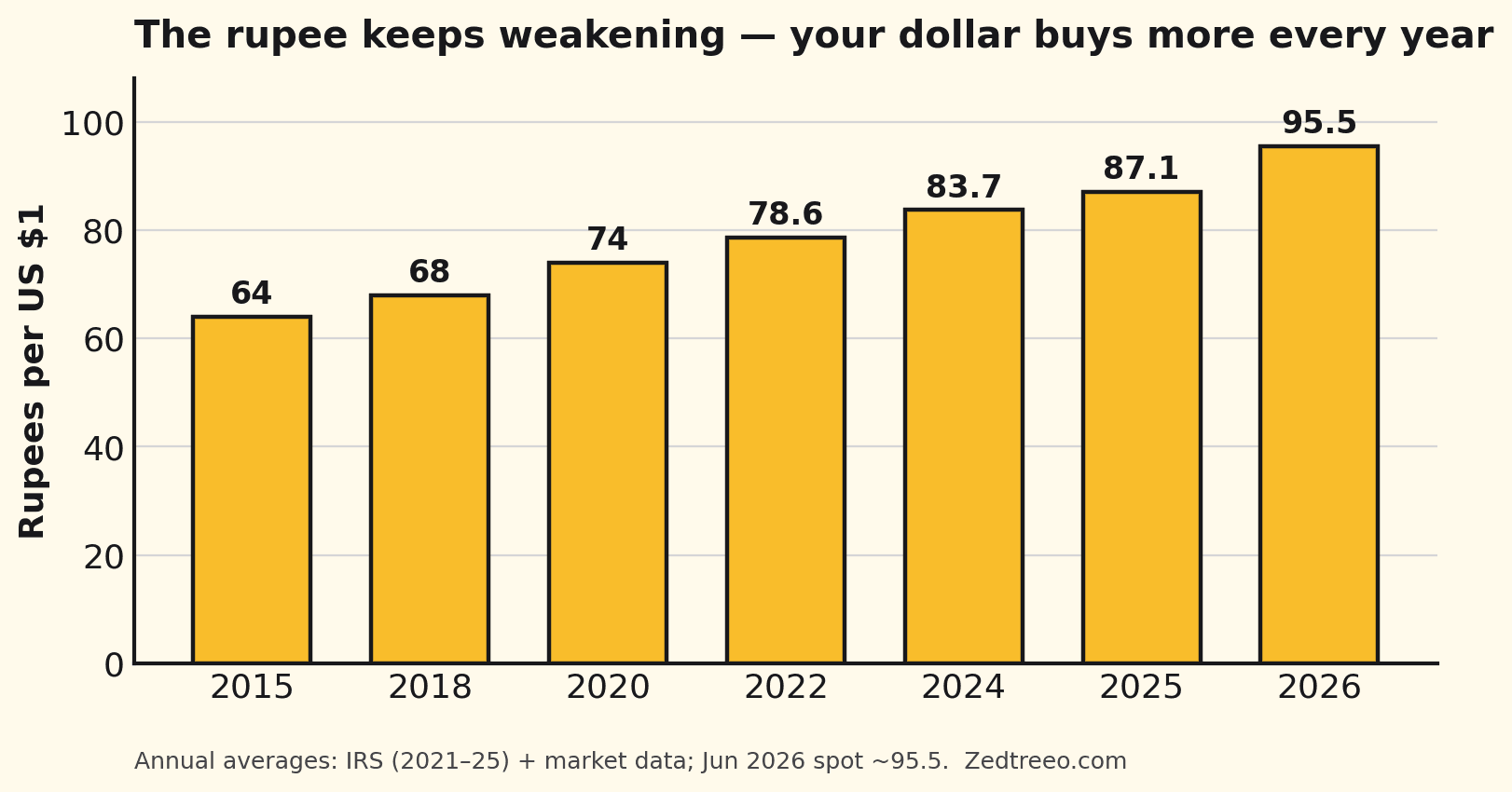
"Dedicated remote staff from $5/hour." If your first reaction is what's the catch? — good. A skilled professional for a fraction of a US salary means one of two things: there's a structural economic reason the price is low, or you're about to fund an expensive education in everything that goes wrong with cheap outsourcing.
This guide makes the honest case for the first — and refuses to dodge the second. You'll see exactly where the savings come from, what the rest of the market actually charges, why the price has become more sustainable over the last decade, and the question most outsourcing pages won't touch: once you add the hidden costs, do you really still save?
- Buyers who see a $5/hour rate and assume it must be a trap
- Founders and finance leads pricing their first offshore hire
- Anyone comparing offshore economics against local hiring costs
How we sourced this
FX and purchasing-power figures reflect mid-2026 market rates and public PPP data as cited in the worked examples; staffing rates are Zedtreeo's published 2026 tiers ($5–$10/hr). Last reviewed July 2026.
The short answer: three engines, not a discount
A low rate that lasts isn't a promotion — it's the output of three durable forces:
- Wage arbitrage — the same skill is priced differently by geography.
- Currency + cost of living — a dollar stretches about 4× further in India than the exchange rate implies, and that gap has been widening.
- Eliminated overhead — no benefits load, office, equipment, or recruiting fees.
Stacked together, a role that costs ~$85/hour fully loaded in the US can land at $8–10/hour — with no one underpaid for their own market.
Engine 1 — Wage arbitrage: the same skill, a different market
A developer is a developer. But the US median salary is $133,080/year (US Bureau of Labor Statistics, May 2024); the same role in India averages roughly ₹6.8 lakh — about $7,100/year. That isn't a skill gap; it's a market gap, set by local supply, demand, and cost of living. It repeats across every function:
| Role | US (loaded ≈/hr) | Zedtreeo | You save |
|---|---|---|---|
| Software developer | ~$85 | $8–10/hr | ~88% |
| Digital marketer | ~$42 | $6–8/hr | ~83% |
| Bookkeeper / accountant | ~$32 | $6–8/hr | ~78% |
| Medical biller / RCM | ~$32 | $6–8/hr | ~78% |
| Virtual assistant / admin | ~$30 | $5–6/hr | ~82% |
| Customer support | ~$26 | $5–6/hr | ~79% |
US figure = BLS median wage + ~30–35% benefits & overhead, per hour. Most roles save 70–90% versus a comparable local hire.
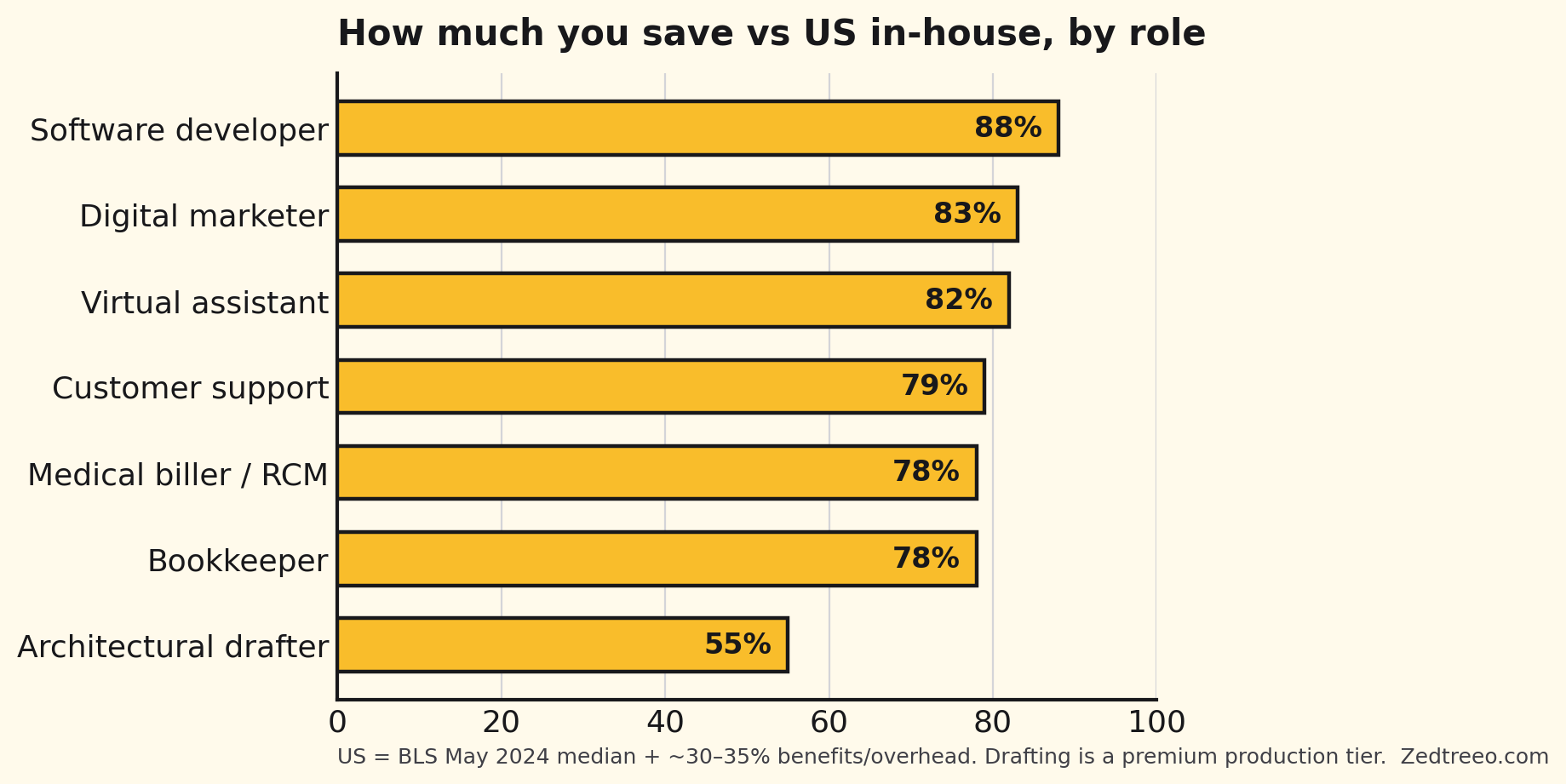
Cost savings by role versus a comparable US in-house hire.
The more expensive the role is in the US, the bigger the saving — because our pricing is anchored to local cost of living, not to US wages. The two are decoupled.
Engine 2 — The currency gap (the part nobody explains)
The nominal exchange rate is about ₹95.5 to the dollar. But measured in purchasing power — what a dollar actually buys — $1 is worth only about ₹22 in India (World Bank PPP data). That ~4× wedge between the exchange rate and real buying power is the engine, and it's structural, not a discount that resets. A specialist can earn a strong, middle-class wage for their market and still cost you a fraction of a US hire. You aren't underpaying anyone — you're buying into a different cost-of-living economy.
The currency tailwind: why $5 today is more sustainable than $5 was five years ago
Here's the part almost no provider will tell you — and it's the strongest evidence the price is real.
The rupee has steadily weakened against the dollar for over a decade. Each dollar you send now converts to far more rupees than it did a few years ago:
| Year | ₹ per $1 (avg) | $5/hour = |
|---|---|---|
| 2015 | ~₹64 | ₹320/hr |
| 2018 | ~₹68 | ₹340/hr |
| 2020 | ~₹74 | ₹370/hr |
| 2022 | ₹78.6 | ₹393/hr |
| 2024 | ₹83.7 | ₹419/hr |
| 2025 | ₹87.1 | ₹436/hr |
| 2026 | ~₹95.5 | ₹477/hr |
Yearly averages: IRS (2021–2025) + market data. June 2026 spot ~₹95.5.
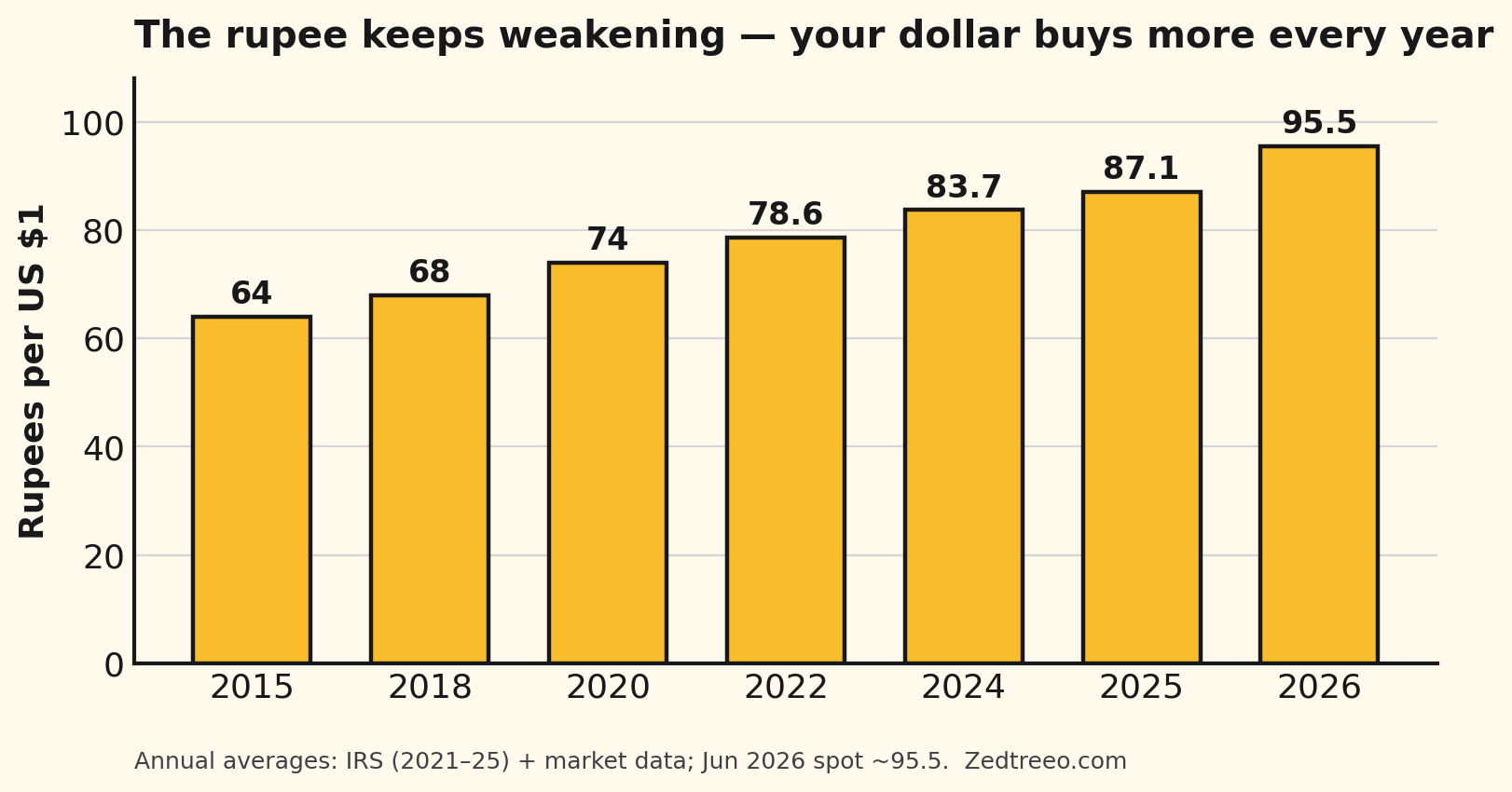
Rupees per US $1 by year — your dollar buys more local labor every year.
Now the insight that follows: many providers set their dollar rates years ago, when the dollar bought fewer rupees — and they still charge the same dollar value today. A role priced at "$5/hour" in 2015 earned ₹320 an hour. The identical $5/hour today earns ₹477 an hour — nearly 50% more in rupee terms — with zero increase to the client's dollar price.
That cuts two ways, both good:
- For you (the client): the saving isn't eroding with inflation — the currency trend has been widening the gap in your favor. A flat dollar price is, in real terms, a falling one.
- For the specialist: that ~50% rupee uplift is what funds competitive raises without dollar price hikes. India's salary increments have run ~8.8–10% a year (2021–2025); the currency tailwind is a big part of how providers keep paying — and retaining — good people while holding the line on client pricing.
In other words, the $5–10/hour band has a built-in cushion. It isn't a teaser rate one depreciation away from collapse — it's a price the macro environment has been quietly strengthening.
Engine 3 — The overhead you stop carrying
A US salary is only the visible part of a US hire. Layer on ~30% in benefits, plus office space, equipment, software licenses, and recruiting fees of 15–25% of first-year pay — and the true cost balloons past the salary line. A managed remote hire folds all of it into one transparent hourly rate: no payroll tax, no PTO accrual, no laptop to ship, no recruiter invoice, no desk.
What the market actually charges
"Cheap" only means something in context. Here's the real landscape for the same dedicated, full-time offshore professional:
| Model | Typical full-time cost | What you manage | Continuity |
|---|---|---|---|
| US in-house | ~$3,000–$11,000/mo (loaded, by role) | Everything | High — but expensive |
| Freelancer marketplaces | ~$1,200–$2,400/mo equivalent | Vetting, management, QA, churn | Low (multi-client) |
| Premium VA agencies | ~$1,700–$2,850/mo | Little | Good |
| Established dedicated-staffing firms | ~$1,100–$2,000/mo | Little | Good |
| Zedtreeo | ~$800–$1,600/mo ($5–10/hr) | Little | Dedicated + vetted + QA |
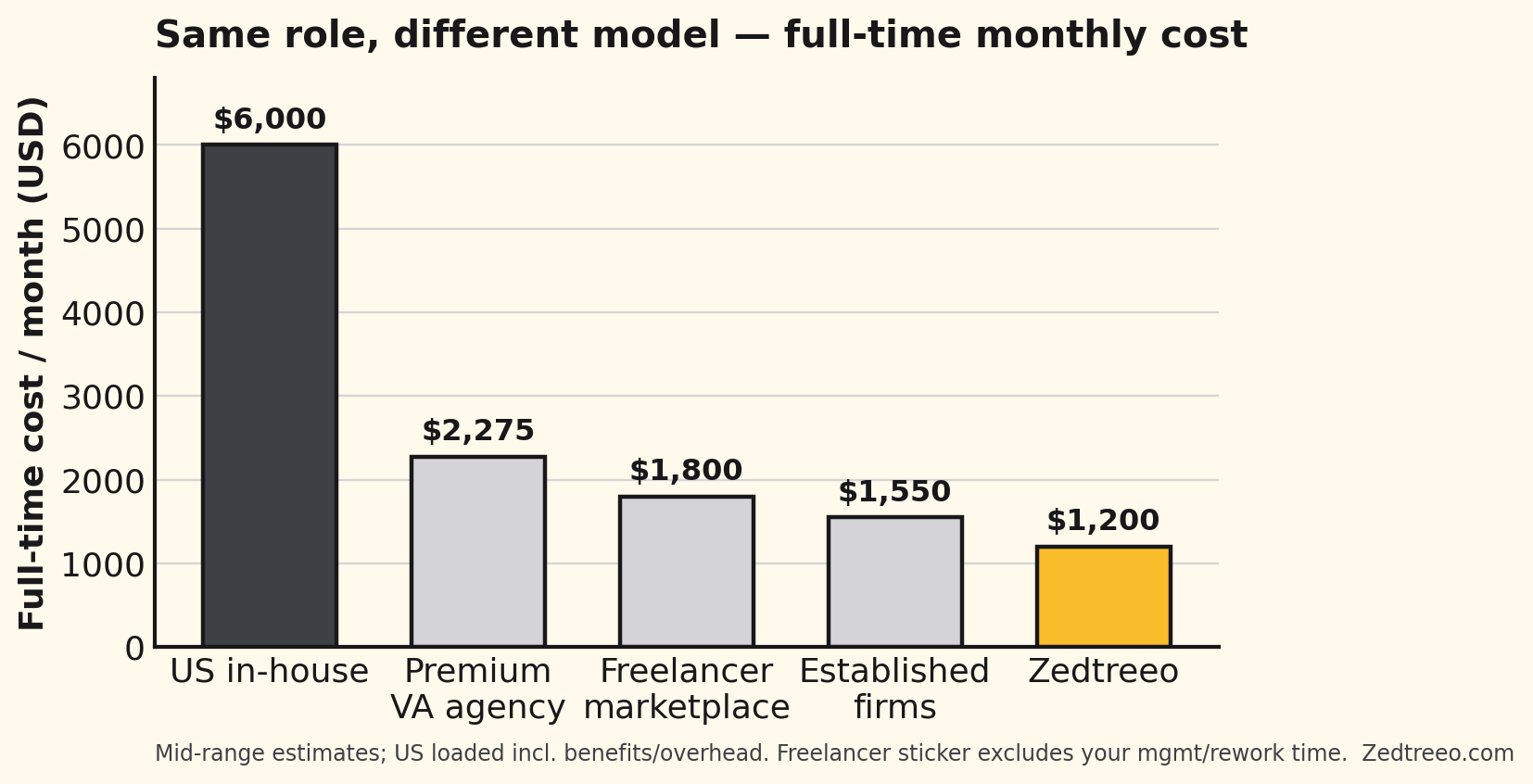
Full-time monthly cost for the same role across hiring models.
Even among India-based providers there's a 2–3.5× spread — premium agencies charge full-time rates that are multiples of ours for comparable roles. And the cheapest sticker (freelancer marketplaces) is rarely the cheapest outcome, because you absorb the vetting, management, and rework yourself.
"But don't hidden costs eat the savings?"
The sophisticated objection — and for badly-run outsourcing, it's true. Transition periods can run three months to a year with a ~20% productivity dip; communication friction can add 3–27%; rework can consume 40–70% of a project budget; and churn in hot offshore hubs can hit double the ~15% baseline. The skeptics' line — "nobody really saves 80%" — is fair about the freelancer / DIY / project-shop model: rotating contractors, no continuity, no QA, no one accountable for retention.
The managed, dedicated model is engineered to plug each leak:
- Quality gap → vetting. Only about 1 in 12 applicants passes screening, so you don't pay to fix junior work.
- Turnover → the provider owns retention. A dedicated hire stays and compounds — month six knows your business in a way no freelancer can. Backup coverage is built in.
- Communication → English-vetted and timezone-aligned. Your hire works your hours; the time difference becomes overnight progress, not lag.
- Rework → SOPs and multi-stage QA, not transactional one-offs.
- Transition & recruiting cost → absorbed by the provider.
Net of the very hidden costs the critics name, the structural savings hold — because we removed their causes. As total cost of ownership for one full-time mid-skill role:
| Model | Sticker / mo | Hidden load | Effective / mo |
|---|---|---|---|
| US in-house | ~$5,500 | + recruiting, mgmt, ramp | ~$6,000+ |
| Freelancer marketplace | ~$1,200–$2,400 | + your time, churn, rework | leaks upward |
| Premium agency | ~$1,700–$2,850 | low | ~$1,700–$2,850 |
| Zedtreeo (dedicated, managed) | ~$800–$1,600 | minimal (provider-absorbed) | ~$800–$1,600 |
The column that matters is effective monthly cost, and it reorders the field. A US in-house hire's ~$5,500 sticker quietly becomes $6,000+ once recruiting, management, and ramp costs land on it, while freelancer marketplaces — the 'cheap' option — leak upward through churn and rework you can't budget for in advance. The dedicated managed model holds its $800–$1,600 sticker because the provider absorbs the hidden work. Even against a premium agency, that's roughly half the effective cost for the same class of role.
How the vetting actually works (the 1-in-12 funnel)
"Pre-vetted" is doing a lot of work in that table, so here's what it means concretely. For every twelve applicants, roughly one is placed. The funnel runs: résumé and credential screen → skills and tools assessment → a role-specific technical test → an English-communication evaluation → a background check → and a trial task. The output isn't "the cheapest person who applied" — it's a professional who cleared six gates before you ever interview them. That's the mechanism that turns a low rate into reliable work, and it's the single biggest difference between managed staffing and a marketplace where anyone can list a profile.
Why India, specifically
The currency and wage math works in several countries, but India pairs it with scale and fit: one of the world's largest English-speaking professional workforces, around 1.5 million STEM graduates a year, deep benches in software, finance, healthcare RCM, and operations, and working hours that can be aligned to US time zones for real-time overlap or deliberate overnight turnaround. It's why India's IT-BPM sector has anchored global delivery for two decades — the talent depth is as much the draw as the price.
Three worked examples
Bookkeeper. A US full-charge bookkeeper runs $60–82k/year — about $32/hour loaded. A dedicated, vetted Zedtreeo bookkeeper is $6–8/hour: roughly $2,000/month versus ~$5,500/month loaded in-house. That's ~75–80% saved on a function you need every month — exactly where dedicated continuity beats freelancer churn.
Medical biller / RCM. A US Medical Records Specialist medians $50,250/year (BLS, 2024). A vetted offshore biller runs $6–8/hour, under ISO 27001:2022-certified controls with HIPAA-aware handling for patient data. Same ~78% gap on recurring revenue-cycle work that rewards a stable, trained hand.
Software developer. US median $133,080/year — about $85/hour loaded. A dedicated developer runs $8–10/hour: the steepest saving (~88%), precisely because US engineering wages are so high while our rate stays anchored to local cost of living.
A quick real-world shape
The pattern most firms see: a US company replaces an open, hard-to-fill seat — say a bookkeeper they'd been quoting at $5,500/month loaded — with a dedicated remote hire at ~$2,000/month. The first month is ramp; by month three the hire is running the close independently; by month six they're suggesting process improvements. The saving is real and the relationship deepened — the opposite of the rotating-freelancer experience the skeptics rightly warn about.
Is it ethical?
The rate you pay is not all wage. It funds a full managed-employment stack — vetting, management, equipment, benefits, QA, and a replacement guarantee. The professional earns a competitive wage for their market, which, thanks to that ~4× cost-of-living gap (and the currency tailwind funding annual raises), supports a solid local standard of living. This is structured, benefits-backed employment — not gig piecework. The savings come from currency and removed overhead, never from squeezing the person doing the work. That's why it's durable: nothing here depends on anyone being underpaid.
How to capture the savings — without the pitfalls
- Hire dedicated, not rotating freelancers — continuity is where the compounding value lives.
- Insist on vetting, SOPs, and QA — that's what keeps "cheap" from becoming "expensive."
- Start with a trial before you commit.
That's how Zedtreeo is built: pre-vetted specialists, a 5-day risk-free trial, your-timezone hours, and one transparent rate. See the full role-by-role math on our pricing page, model your own numbers with the salary comparison tool and cost calculator, or get a free shortlist.
How to actually hire $5–10/hour remote staff from India (step by step)
The economics are real — here is how to go from "this sounds good" to a working hire, start to finish.
- Start with one role. Don’t rebuild your whole team at once. Pick the function bleeding the most hours — usually bookkeeping, a virtual assistant, or customer support.
- Write a one-paragraph brief. Tasks, the tools you use, hours per week, and the working-hours overlap you need. That is enough to source against.
- Get a vetted shortlist in 48 hours. A good provider returns 2–3 pre-vetted, English-fluent candidates matched to your brief — not a marketplace of 200 profiles to sift through. Get your shortlist.
- Trial before you commit. Test real output and communication for a few days. Zedtreeo includes a 5-day risk-free trial — no contract, no upfront fee.
- Onboard into your tools and SOPs. Share logins, a short walkthrough, and your runbook. Most dedicated hires are productive inside the first week.
- Keep them dedicated, then scale. One person, your hours, building real institutional knowledge — add the next role once the first is humming.
Want to model the numbers for your business first? Run your role through the cost calculator or see transparent pricing — starting at $5/hour, 70–90% below equivalent local hires globally.
Frequently asked questions
Why is offshore staff so much cheaper — is the quality lower?
No. The price reflects a labor-market and currency gap plus removed overhead, not skill. Quality risk comes from how you hire — rotating, unvetted freelancers — which a dedicated, vetted model addresses.
Don't hidden costs cancel out the savings?
They can, in unmanaged freelancer-style outsourcing (transition, rework, turnover). A vetted, dedicated, provider-managed model removes those drivers, so 70–90% net savings hold.
If the rupee keeps weakening, will prices rise?
The opposite pressure, if anything. A weaker rupee means your dollar buys more local labor, so the dollar price band is well-supported — the currency trend has worked in clients' favor for a decade.
Other India-based providers charge far more — why are you lower?
Transparency and structure. Premium agencies bundle a markup into $1,700–$2,850/month packages; we price openly at $5–10/hour — the professional plus the management layer, not a brand premium.
Is paying $5–10/hour exploitative?
No. Specialists earn a competitive local wage (which goes about 4× further than the exchange rate implies) under full managed employment with benefits. Savings come from currency and overhead, not underpayment.
How is my data protected?
Work runs under ISO 27001:2022-certified controls, with NDAs and HIPAA-aware handling for sensitive finance and healthcare workflows. See our Legal & Compliance page.
Which roles work best?
Recurring, ongoing functions — bookkeeping, medical billing/RCM, development, marketing, admin, customer support — where a dedicated hire compounds business knowledge over time.
Sources: US BLS OEWS/OOH (2024 wages); World Bank PPP (India); IRS yearly-average USD/INR (2021–2025) plus June 2026 spot; India salary-increment surveys (2021–2025); BPO market size (Coherent / Intel Market Research, 2025); outsourcing hidden-cost and attrition analyses (CIO, MicroSourcing, 2025); publicly listed provider pricing (anonymized).
Do these rates apply to every role?
The $5/hr floor applies to non-skilled and entry operational roles; mid-skill work (finance, ops, support) runs $6–$8/hr and technical roles $8–$10/hr. Every rate is confirmed against the specific role brief — the tiers are the honest range, not a teaser.
Where to go next
Ready to act? See our transparent pricing, hire a virtual assistant or a remote bookkeeper, or run your own numbers in the cost calculator.
Related Guides
- The Offshore Staffing Rate Index — 2026 Edition (every role, every rate, with methodology)
- The Currency Gap — why the economics work
- Zedtreeo Pricing