I have spent sixteen years on the supply side of a market almost everyone discusses and almost no one understands. In that time I've helped place more than 500 specialists with companies in the US, the UK, and Australia, and I've sat through hundreds of conversations that open the same way: a founder leans in and asks, half-hopeful and half-suspicious, "How is this so cheap?"
It's the right instinct and the wrong question. "Cheap" is the frame that ruins these decisions. It's the word that makes good operators either overpay out of fear or underpay into disaster. I want to retire it — and replace it with something more useful: the currency gap, and what it really tells you about where your money is going.
The debate is rigged — both sides are wrong
There are two camps, and they deserve each other.
The first camp sells offshore talent as "cheap labor." You've read their landing pages: 70% savings, hire a developer for the price of a coffee. This camp treats the price as the product. It is the reason the whole category carries a faint smell of something too good to be true.
The second camp — usually consultants, onshore vendors, and the occasional burned CFO — exists to debunk the first. Nobody really saves 80%, they say. By the time you count transition, rework, churn, and management overhead, that $10,000-a-year hire costs you four times as much. And here's the uncomfortable part: on their own terms, they are correct. I've watched it happen. I've seen the rework. I've seen the three-month ramp that produced nothing. The hidden costs are real.
What neither camp will tell you is that they are describing two different products and pretending it's one argument. The first camp is selling price. The second is criticizing unmanaged price. Neither is describing what actually creates — or destroys — value in this market. That's the currency gap, and it sits underneath both of them.
What's actually underneath the price
Strip away the marketing and the number resolves into three plain forces: the same skill is priced differently across labor markets; a dollar buys far more in India than the exchange rate suggests; and a remote hire carries none of the overhead — benefits, office, equipment, recruiting fees — that doubles the true cost of a domestic one. I've laid out the full arithmetic, role by role, in a separate piece; I won't repeat the tables here.
The one number worth holding onto is the gap between the exchange rate and purchasing power. The dollar trades at roughly 95 rupees today. But measured in what it actually buys — a meal, a month's rent, an hour of skilled labor — a dollar is worth closer to 22 rupees inside India (this is the World Bank's purchasing-power-parity figure, and it has been remarkably stable). That roughly four-to-one wedge is not a discount anyone is granting you. It is the structural difference between two economies. It does not go on sale and it does not expire.
That distinction matters more than any savings percentage, because it tells you the saving is real in a way a coupon never is. You are not getting a deal. You are getting access to a different cost basis. A discount is something a seller can withdraw the moment leverage shifts. A cost basis is geography. No quarterly review reverses it, no sales manager claws it back, and — this is the part that took me years to fully appreciate — it has been quietly compounding in the buyer's favor the entire time I've been in this business.
The part nobody mentions: the gap has been widening
Here is the fact that reframed how I think about my own business.
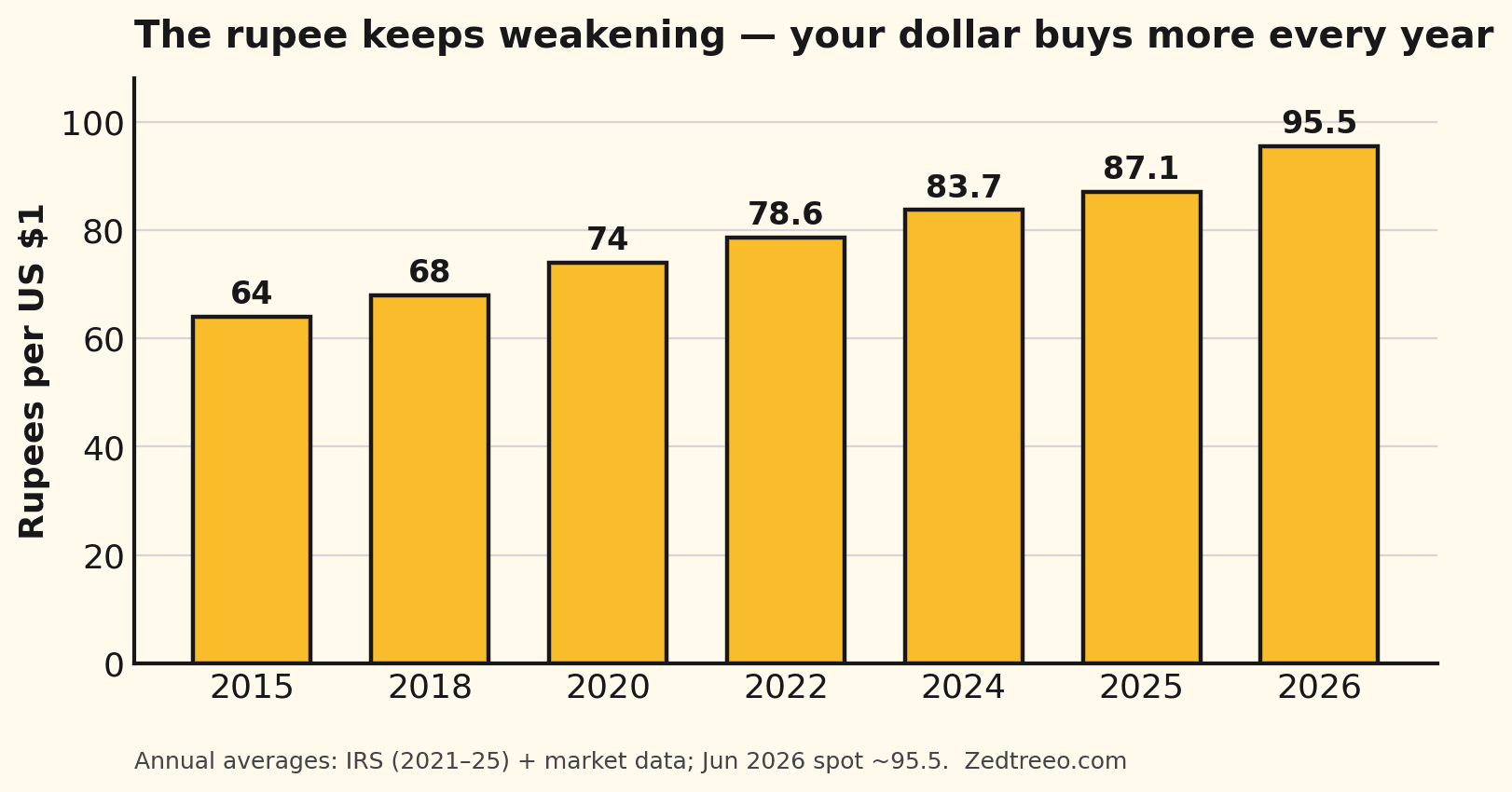
When I started, the rupee traded in the mid-forties to the dollar. By 2015 it was around 64. It crossed 70, then 74 through the pandemic, 78, 83, 87 — and as I write this, about 95. The line goes one direction, decade after decade.
Now consider what that does to a dollar price that doesn't move. A provider who set "$5 an hour" in 2015 was collecting about 320 rupees for that hour. The identical $5 today converts to roughly 477 rupees — nearly 50% more in local terms — with no change to what the client pays. The dollar price stood still while its purchasing power inside India grew.
I find this is the single most clarifying fact in the entire conversation, because it quietly answers the skeptic. If the model only worked at a particular exchange rate, a decade of depreciation would have broken it. Instead the opposite happened: the macro environment has spent ten years strengthening the arrangement. A flat dollar price, in real terms, has been a falling one.
It also raises a question I think every buyer should ask their provider, and almost none do: where did that 50% go? Because this is where good operators and bad ones separate, and I'll come back to it.
The four ways buyers actually overpay
In my experience the companies bleeding money on this decision are rarely the ones who "went offshore and got burned." They're the ones who made one of four quieter mistakes.
One — the fear tax. This is the most expensive line item I see, and it never appears on a budget. It's the company that keeps a function fully in-house at four or five times the cost, not because the work demands it, but because cheap set off an alarm and they never investigated further. They are paying a premium to avoid a risk they never actually measured. The fear is reasonable; the refusal to test it is not. A five-day trial costs nothing and dissolves most of it.
Two — the brand-premium markup. At the other end sit the buyers who did go offshore but routed through a premium agency charging $2,000 to $2,850 a month for a full-time hire — drawing from the same talent pool, in the same cities, that other firms staff at a third of the price. Some of that markup buys real polish. Much of it buys a brand and a sales team. If you cannot articulate what the premium is for, you are likely paying for someone else's marketing.
Three — the cheapest-sticker trap. The mirror image: the buyer who optimized purely on rate, hired the lowest bid on a freelancer marketplace, and discovered that the sticker price excluded everything that makes work usable — vetting, management, continuity, a second set of eyes. This is the buyer the skeptics are describing. They didn't overpay on the invoice. They overpaid in their own nights and weekends, and in the rework no one logged.
Four — the flat-dollar provider. This is the subtle one, and it's the answer to where did the 50% go. A decade of currency tailwind handed providers a windfall on every flat-priced hour. The good ones reinvested it — into wages, into retention, into the training and management layer that keeps a dedicated hire improving past month six. The extractive ones simply pocketed it, held wages flat, and watched their best people churn out the back door, which the client then pays for in turnover and lost context. From the outside the two look identical on the rate card. You tell them apart by asking about attrition, about how long their average placement stays, about whether wages have moved with the currency. The number that should reassure you isn't the price. It's the retention.
Putting a number on the fear tax
Let me make the most common mistake concrete, because abstractions don't move budgets.
Take a US company carrying one full-charge bookkeeper in-house. Salary somewhere around $65,000; load in benefits, payroll tax, software seats, and a share of office cost, and the real number lands near $5,500 a month. That's not extravagant — it's just what a competent finance hire costs in a high-wage economy.
Now suppose the same firm could run that function with a dedicated, vetted remote bookkeeper for roughly $2,000 a month. The difference is about $3,500 a month — north of $40,000 a year — on a single seat. A company with three such roles is leaving six figures on the table annually. Not in theory; in the bank.
The firms that pay this tax almost never decided to. They didn't run the comparison and judge the saving not worth the risk. They never ran the comparison at all, because cheap tripped an instinct and the instinct ended the conversation. I understand the instinct — I'd be wary too. But there's a difference between pricing a risk and flinching from it. Pricing it costs you a week and a trial. Flinching from it costs you the fear tax, every month, forever.
What sixteen years actually changed
When I started, the work that moved offshore was the work nobody wanted: data entry, first-tier support, the back of the back office. The pitch was purely cost, and the quality skepticism was, frankly, often earned.
That world is gone, and the people still arguing about offshore talent as if it were 2009 are fighting the last war. The work we place now is core, not peripheral: the developers shipping the product, the analysts closing the books, the billing specialists protecting a clinic's revenue cycle. The talent depth caught up — India alone graduates well over a million STEM students a year — and remote tooling erased the coordination penalty that used to make distance expensive.
AI has bent the line further, in a way that surprises people who expect it to make remote staff obsolete. The opposite is happening in our book. AI raises the floor on routine output, which means the differentiator is no longer who can do the task but who can manage, judge, and direct the tools doing it — and that judgment is exactly what a vetted, dedicated professional brings and a rotating freelancer doesn't. The currency gap made offshore talent affordable. The capability gap closing is what made it good. Both are true at once now, and that combination is genuinely new.
The trust infrastructure matured alongside the talent. The objection that used to end deals — how do I know my data is safe halfway around the world? — was once a fair stopping point. Today the serious providers operate under ISO 27001-certified controls, sign NDAs as a matter of course, and handle regulated finance and healthcare data under documented frameworks. That doesn't make security a non-issue; it makes it a question with verifiable answers instead of a vague fear. A decade ago you took it on faith. Now you ask for the certificate, the access-control policy, and the breach-response SLA, and a credible provider hands them over. The bar moved from "trust us" to "here's the evidence" — and that shift, quiet as it was, did more to legitimize the model than any price could.
It's also why I get impatient with the cost-only framing. If the only thing you're buying is cheapness, you've understood neither what's changed nor what you're actually paying for.
Hire better, not just cheaper
The thread running through all four mistakes is the same: each one treats price as the whole decision. Get the price right and you've won; get it wrong and you've lost. But price was never the variable that determined the outcome. Structure was.
The currency gap is what makes the savings possible. It is not what makes the engagement work. What makes it work is everything the price debate ignores — whether the person was vetted before you ever met them, whether they're dedicated to you or juggling five clients, whether someone is accountable for their output and their retention, whether the provider treated the currency tailwind as a reason to invest or an excuse to extract. Those are the variables. The rate is just the entry ticket.
So the reframe I'd offer any buyer is this: stop asking how is it so cheap and start asking what am I actually buying for the rate. The answer separates a structural advantage you can build a company on from a false economy you'll spend a year regretting. Same price. Completely different decision.
Four questions that reveal which provider you've got
If the structure is what matters, then due diligence should interrogate the structure — not the rate card. After sixteen years on the other side of these calls, here are the four questions I'd ask, in order, and what the answers tell you.
What is your annual attrition, and how long does your average placement stay? This is the single most revealing number, because it exposes whether the provider reinvested the currency tailwind or pocketed it. Low attrition means your hire will still be there — and still improving — at month eighteen. High attrition means you'll be re-explaining your business twice a year.
Is this person dedicated to us, or shared? Shared capacity is a marketplace wearing a staffing-agency costume. Continuity is where the compounding value lives, and you only get it from a dedicated hire.
What does your vetting actually filter out? "Pre-vetted" is meaningless until they describe the funnel. You want to hear about a real screen — skills, communication, a trial task — not a résumé skim.
Can we start with a trial? A provider confident in their vetting will let the work speak before you commit. A provider who resists is telling you something.
Notice that none of these four questions is about price. That's the point.
What we decided to do about it
I'll be direct about where I sit, because you should weigh it accordingly. We built our company on the opposite of the flat-dollar extraction model. We price openly — five to ten dollars an hour, published, not negotiated behind a quote form. We vet hard enough that roughly one applicant in twelve is placed, because the rate only means something if the work is reliable. We run dedicated, not rotating, because continuity is where the value compounds. And we treat the currency tailwind as what it is — the thing that funds competitive local wages and keeps good people from leaving, which is the only durable way to protect a client's investment.
None of that is charity. It's the recognition that in this market the cheapest provider and the best provider are not the same firm, and the gap between them is paid by the client. We'd rather be the second one.
The currency gap is real, it's structural, and for a decade it has been moving in the buyer's favor. The opportunity it creates is genuine. But it rewards the companies that look past the number to the structure underneath it — and quietly penalizes the ones who don't. After sixteen years, that's the only lesson I'd insist on.
Sources and how the numbers were derived
Exchange rate. USD/INR of roughly 95 is the Reserve Bank of India reference rate as of mid-2026, rounded; the mid-forties (2009) and ~64 (2015) figures are the same series for those years. Purchasing power. The "about 22 rupees" figure is the World Bank's PPP conversion factor for India (private consumption, LCU per international $), which measures what a dollar buys inside India rather than what it exchanges for. Rates. Zedtreeo's own published rate history (2010–2026) and the current Rate Index; agency and freelancer price points are the ranges quoted publicly by named competitors at the time of writing and are illustrative. US comparators where used are BLS OEWS May 2025 national medians. Nothing in this essay is a forecast; the exchange-rate and PPP figures move, and the argument holds at any point in the range seen since 2015.
Frequently Asked Questions
What is the currency gap in offshore staffing?
The dollar trades at roughly 95 rupees, but measured in what it actually buys inside India — a meal, a month's rent, an hour of skilled labour — it is worth closer to 22 rupees. That is the World Bank's purchasing-power-parity figure, and it has been remarkably stable. The roughly four-to-one wedge between those two numbers is the currency gap. It is not a discount a seller is granting you; it is the structural difference between two economies, which means it does not go on sale and it does not expire.
Has offshore staffing become cheaper or more expensive over the last decade?
Cheaper in real terms, because the dollar price stood still while its purchasing power inside India grew. The rupee traded in the mid-forties when I started, was around 64 by 2015, and is about 95 today. A provider who set five dollars an hour in 2015 was collecting about 320 rupees for that hour; the identical five dollars today converts to roughly 477 rupees — nearly 50% more in local terms, with no change to what the client pays.
Do companies really save 70 to 80 percent by hiring offshore?
Both camps in that argument are describing different products and pretending it is one debate. The critics are correct on their own terms: once you count transition, rework, churn and management overhead, an unmanaged cheap hire can cost several times its rate. But they are criticising unmanaged price, not the model. The saving is real because it comes from a different cost basis rather than a coupon — what determines whether you capture it is structure, not rate.
What is the fear tax in outsourcing decisions?
It is the most expensive line item I see and it never appears on a budget: a company keeping a function fully in-house at four or five times the cost, not because the work demands it, but because the word cheap set off an alarm nobody investigated. They are paying a premium to avoid a risk they never measured. The fear is reasonable; the refusal to test it is not. A five-day trial costs nothing and dissolves most of it.
How much does the fear tax actually cost per seat?
Take a US company carrying one full-charge bookkeeper in-house. Salary around $65,000; load in benefits, payroll tax, software seats and a share of office cost and the real number lands near $5,500 a month. The same function run by a dedicated, vetted remote bookkeeper is roughly $2,000 a month. That is about $3,500 a month — north of $40,000 a year — on a single seat. A company with three such roles is leaving six figures on the table annually.
What are the four ways buyers overpay for offshore talent?
The fear tax, keeping work in-house at several times the cost without ever running the comparison. The brand-premium markup, routing through a premium agency at $2,000 to $2,850 a month for the same talent pool other firms staff at a third of the price. The cheapest-sticker trap, optimising purely on rate and discovering the sticker excluded vetting, management and continuity. And the flat-dollar provider, who pocketed a decade of currency tailwind instead of reinvesting it in wages and retention.
What questions should I ask an offshore staffing provider?
Four, in order. What is your annual attrition, and how long does your average placement stay — this exposes whether the provider reinvested the currency tailwind or pocketed it. Is this person dedicated to us, or shared. What does your vetting actually filter out, described as a funnel rather than a résumé skim. And can we start with a trial. None of the four is about price, which is the point.
Does AI make offshore remote staff obsolete?
The opposite is happening in our book. AI raises the floor on routine output, which means the differentiator is no longer who can do the task but who can manage, judge and direct the tools doing it — and that judgment is exactly what a vetted, dedicated professional brings and a rotating freelancer does not. The currency gap made offshore talent affordable; the capability gap closing is what made it good.
Chandra Prakash is Co-Founder of Zedtreeo. For the full role-by-role economics behind offshore staff pricing, see How Can Remote Staff Cost $6–10/Hour? Sources: US BLS (2024 wages); World Bank PPP (India); IRS yearly-average USD/INR (2021–2025); India salary-increment surveys (2021–2025).