
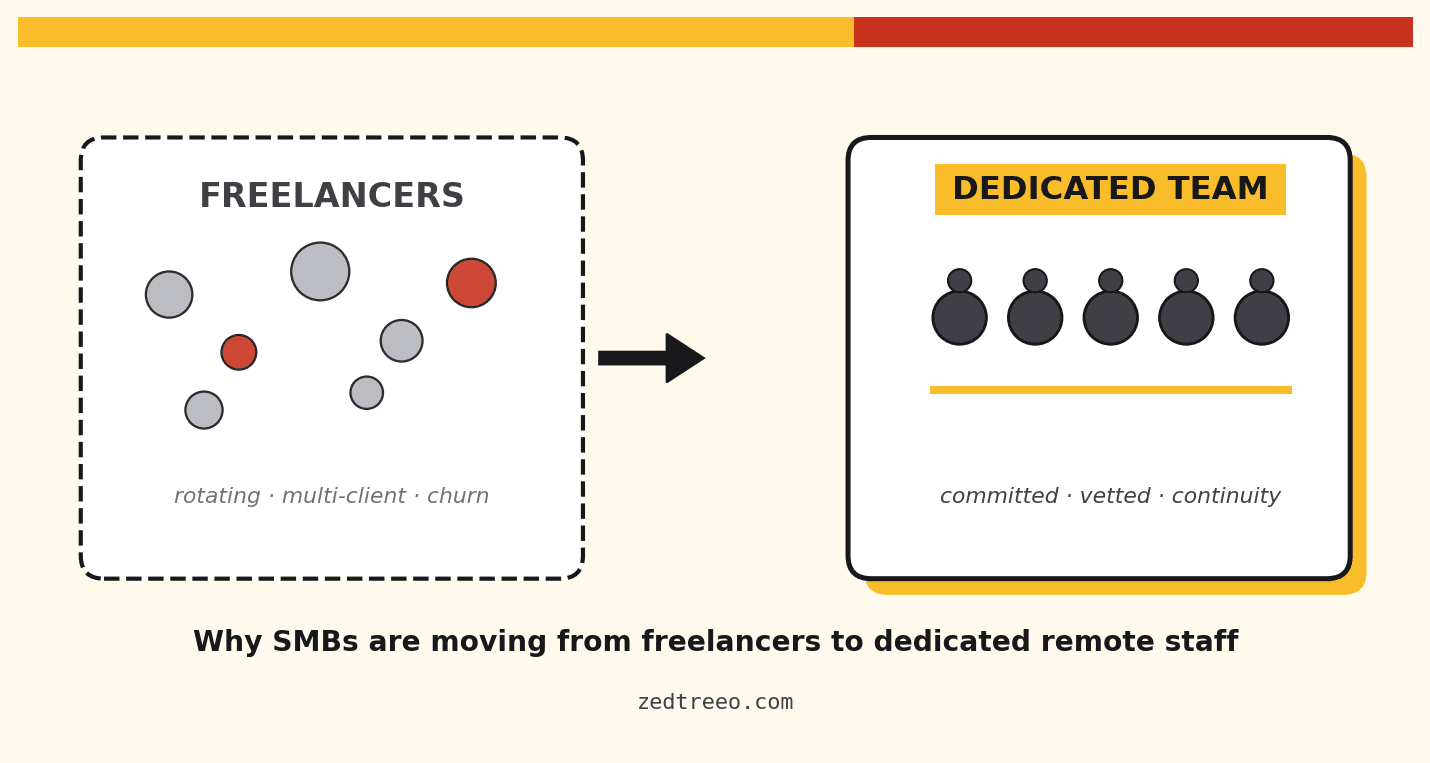
- SMB owners stuck re-briefing a rotating cast of freelancers
- Businesses whose recurring work has outgrown the marketplace model
- Ops leads formalizing operational roles that freelancers keep churning through
Looking for the side-by-side? The spec-level comparison — cost per productive hour, reliability, IP and continuity — lives on Dedicated Remote Staff vs Freelancers. This piece is about why businesses make the switch and how to tell when you should.
How we sourced this
Cost-math figures use published 2026 freelance-platform fee structures and market rates alongside Zedtreeo's 2026 dedicated-staffing rates ($6–$10/hr by skill tier). Individual comparisons depend on hours, role seniority, and rework frequency. Last reviewed July 2026.
Quick Answer
SMBs are switching from freelancers to dedicated remote staff because freelancers churn 3–4× more often, platform fees add 15–32% in hidden costs, and freelancers split focus across 3–8 clients on average. Dedicated remote staff cost from $6/hour all-inclusive, work exclusively for one business, and deliver 40–80% lower total cost of ownership over a 12-month period than the freelance-marketplace equivalent.
TL;DR — What Changed in 2026
The freelance economy didn't die. It got expensive, less reliable, and harder to manage. After working with 500+ professionals placed globally, the operational gap between "freelancer who shows up for 3 weeks" and "dedicated employee who shows up for 3 years" has become measurable, not anecdotal.
Three forces are pushing SMBs out of the marketplace model and into dedicated remote staffing:
- Hidden fees compound fast. Upwork client costs add 15–18% over the visible rate. Fiverr adds 25–32%. On a $100,000 annual freelance spend, that's $15,000–$32,000 in pure platform overhead before quality, vetting, or retention is considered.
- Churn is breaking ongoing roles. Freelancers for recurring functions churn at 3–4× the rate of dedicated hires. Every replacement cycle resets onboarding cost, context loss, and knowledge transfer.
- Split attention dilutes output. Marketplace freelancers run an average of 3–8 simultaneous clients. Research on context-switching shows cognitive performance drops 20–40% when professionals juggle complex tasks across unrelated environments.
The math stops working somewhere between month 3 and month 6 of any recurring role. After that, dedicated remote staff become the better economic decision — not just operationally, but on every line of the budget.
This guide is built from operational data: the patterns we see across hundreds of SMB engagements at Zedtreeo, where buyers tell us exactly why they left their freelance stack and what changed once they hired dedicated. If you're evaluating the switch — or rationalizing it after the third missed Slack message of the week — this is the decision framework I wish more founders had before they signed up for another marketplace account.
The Freelancer Reality in 2026 — Three Things That Look Different Now
1. The platform-fee tax is no longer hidden
For years, freelance platforms positioned themselves on "no salary, no overhead, pay only for what you use." The headline rate was the rate. That framing has broken down.
A mid-level developer listed at $25/hour on a major marketplace doesn't actually cost $25/hour. The true unit economics, once you add it up:
- Client service fee: up to 7.99% on every payment (some platforms have moved to 5–8% tiered structures)
- Contract initiation fees: $0.99–$14.99 per new contract, every time you start or restart an engagement
- Currency conversion markups: 1–3% when you're paying a freelancer in their local currency from a USD account
- Freelancer fee pass-through: freelancers paying 0–15% on their side typically embed that cost in their rate
- Small-order surcharges: some platforms add $2.50–$3.50 fees on orders under $75–$200
Real cost of a $25/hour marketplace freelancer landing in your P&L: $29–$33 per effective billable hour. On a 160-hour month, that's a $640–$1,280 monthly markup you didn't budget for.
Scale that to a $100,000 annual freelance program and you're paying $15,000–$32,000 in pure platform overhead. That money buys nothing — not vetting, not management, not replacement, not continuity. It's a transaction tax.
2. Quality vetting has effectively zero floor
The original sell of freelance marketplaces was access — millions of professionals, instantly searchable, instantly hireable. Access is still real. Curation is not.
The vetting math on most major freelance marketplaces:
- Anyone with an email address can list a profile
- Self-reported skills are not verified
- Reviews are gameable through volume, refunds, and friendly first-clients
- Certifications are uploaded by the freelancer, not audited
- Portfolio samples are not provenance-checked
Compare this to dedicated remote staffing providers, where credible firms place a single-digit percentage of applicants. Vetting includes structured interviews, role-specific skill testing, English proficiency assessment, and reference verification. The acceptance funnel is intentionally narrow because the placement is meant to last 12+ months, not 12 days.
The cost of unvetted freelancers isn't measured in their hourly rate. It's measured in the retry cycles: hire, watch the work miss spec, fire, rehire, re-onboard, repeat. Every cycle costs 8–15 hours of management time and resets your project clock.
3. Split attention is now structural, not occasional
Five years ago, a freelancer working 3 clients was common. Today, on most major marketplaces, the average active freelancer runs 5–8 simultaneous engagements. Marketplace economics push this — freelancers need volume to clear platform fees and offset gap-time risk.
For an SMB hiring on the marketplace, this is invisible until it isn't. The freelancer who closed your discovery call in 24 hours took six days to ship the next deliverable. The 9 a.m. Slack message gets answered at 4 p.m. — not because they're slacking, but because they were on three other client calls between 10 and 3.
Research on cognitive context-switching shows that switching between unrelated complex tasks reduces effective performance by 20–40%. That's not a focus problem — that's a math problem. A freelancer giving you 25% of their attention isn't giving you 25% of a full-time output. They're giving you 15–20%, because the switching cost is multiplicative.
Dedicated remote staff solve this structurally. A dedicated hire works exclusively for one client. Context-switching cost goes to zero. Their morning standup is your morning standup. Their feedback loop is your feedback loop.
What "Dedicated Remote Staff" Actually Means
Before going further: the term gets abused, so let me be precise.
Dedicated remote staff is a full-time professional, employed and benefitted through a staffing provider, who works exclusively for one client business — not split across a portfolio, not shared on a roster, not subcontracted. The provider handles employment paperwork, payroll, benefits, infrastructure, and replacement risk. The client handles day-to-day management as they would any internal team member.
It's not:
- A freelancer with a fancy name. Freelancers serve multiple clients by design.
- A staff augmentation contractor. Staff aug typically runs through a project-based hourly model with high markups ($40–$150+/hour for technical roles).
- An employer of record (EOR) hire. EOR is a compliance vehicle for hiring someone you already found — it doesn't include sourcing, vetting, or replacement.
- A managed services engagement. Managed services delivers outcomes; dedicated staff delivers labor inside your workflows.
At Zedtreeo, the model is straightforward: we source, vet, and place a full-time professional from our global talent pool. They work your hours, in your tools (Slack, Asana, your CRM, your inbox), under your direction. Pricing starts at $6/hour all-inclusive — that's the employee comp, employer-side contributions, infrastructure, account management, and replacement guarantee. No platform fee. No surprise markup.
8 Reasons SMBs Are Making the Switch
1. Total cost of ownership is 40–80% lower on recurring roles
This is the headline number, and it's the one buyers verify first. A typical comparison for an operations coordinator role over 12 months:
| Cost line | Marketplace freelancer | Dedicated remote staff |
|---|---|---|
| Visible hourly rate | $25/hr | $6–$8/hr |
| Platform fee | 15–18% | $0 |
| Hidden onboarding cycles | 2–3 per year × ~10 hrs management = $1,500–$3,000 | Single onboarding |
| Replacement cost on churn | $2,000–$4,000 per turnover event | Included in provider guarantee |
| Annual all-in cost | $48,000–$58,000 | $9,600–$15,400 |
The savings range is wide because freelancer churn is the variable. The lower bound assumes one freelancer for 12 months (rare). The upper bound assumes three sequential freelancers (closer to typical).
For a head-to-head on per-role savings, our Remote Staffing Pricing page has the current rate card by role tier.
2. Retention is 3–4× better
Freelancers on marketplaces churn because the platform is the loyalty layer, not the client. Pricing pressure, competing offers, and the next-bigger-client opportunity always exist a click away. The average freelance engagement on major platforms runs 23 working days — roughly a month.
Dedicated remote staff stay because employment is structural. They have a contract with the staffing provider, benefits, a manager relationship, and tenure progression. Median engagement length in dedicated remote staffing runs 18–36 months — not a month.
For SMBs in roles where domain knowledge compounds (customer support, financial ops, sales, content, paid media), retention isn't a "nice to have." It's the entire value proposition. A bookkeeper who learned your chart of accounts in month 1 is 4× more efficient in month 6. Lose her and you reset.
3. Hiring time collapses from weeks to days
Counterintuitively, dedicated remote staffing is often faster than freelance hiring, not slower.
Freelance marketplace hiring looks fast at the discovery step (post a job, get 50 proposals overnight) but stalls in vetting. Reading 50 proposals, screening 10, interviewing 3, sending test projects, evaluating — that's 8–12 hours over 5–7 days, and you've spent a quarter of a workweek before anyone has done billable work for you.
Dedicated remote staffing operates differently. The provider runs the vetting funnel for you. You submit a role brief, get 2–4 pre-vetted candidates within 48 hours, interview the top picks, and start within 7–10 days end-to-end. Your involvement caps at the interview stage.
At Zedtreeo, our 48-hour shortlist is the baseline. See How It Works for the full process.
4. Vetting actually exists
I covered this above, but it bears repeating because buyers underestimate it. The single biggest variable in marketplace outcomes is "did the freelancer actually have the skill they claimed?"
Dedicated providers run pre-screening, skill testing, English assessment, and culture-fit interviews before a candidate reaches the client. The single-digit acceptance funnel isn't marketing — it's how providers stay solvent on replacement guarantees. If a placement fails, the provider absorbs the cost of replacing them.
That alignment of incentives is what marketplaces structurally cannot offer. Marketplaces are paid on transactions. Dedicated providers are paid on tenure.
5. Continuity of context — no relearning
Every freelance engagement starts at zero context. The freelancer learns your tools, your style guide, your client list, your product nuances — and then leaves before that learning compounds into output.
Dedicated remote staff compound. A virtual assistant who handles your inbox for 24 months learns the difference between "the client who always pays late but is worth it" and "the client who's about to churn." That's not a skill you can hire — it's a tenure asset. Marketplace economics destroy this asset every 23 working days.
6. Single point of management
Hiring 3 freelancers means managing 3 inboxes, 3 invoicing cycles, 3 currency adjustments, 3 different review patterns, and 3 termination conversations. Hiring 3 dedicated remote staff (say, an ops coordinator + a marketing assistant + a bookkeeper) means one provider relationship, one monthly invoice, one account manager.
SMB founders' calendars get ruined by people management. The dedicated staffing model collapses that into a single weekly check-in with the account manager covering all hires.
7. Compliance and IP risk drop sharply
Freelance marketplaces operate on a network of independent contractors across many jurisdictions. Some of those jurisdictions have begun reclassifying gig workers as employees retroactively. If your business has been treating a freelancer as a recurring contractor for 18 months and a regulator decides that arrangement was de facto employment, the back-tax exposure can be significant.
Dedicated remote staffing providers own the employment relationship. Workers are employed under the provider's entity, not yours. Misclassification risk transfers from you to the provider. IP assignment is handled at the contract level, not negotiated per freelancer.
For SMBs in regulated industries (legal, financial services, healthcare-adjacent), this isn't a "nice to have" — it's a structural exposure that becomes harder to unwind the longer you wait.
8. Replacement is guaranteed, not your problem
A freelancer who goes dark on Monday morning is your emergency. Your work is in their drive, their head, their queue. You spend the week scrambling.
A dedicated remote staff member who leaves is the provider's problem. The provider has been training a bench against this risk from week one. Replacement happens within days, not weeks, and re-onboarding leverages the documentation the provider keeps on your account.
Continuity is sold as a feature in dedicated staffing for a reason: it's the part marketplaces structurally can't promise.
When Freelancers Still Make Sense — And When They Don't
The honest framing: freelancers haven't disappeared from the playbook. They've moved into a narrower band of use cases.
Freelancers still win for:
- One-time projects under 30 days. A logo design, a one-off audit, a single landing page. The relationship doesn't need to compound.
- Highly specialized skills you'll use rarely. A patent illustrator, a 3D animator, a niche translator. Renting access beats employing.
- Pilot tests of new functions. You want to try a new content angle for 6 weeks before committing to a hire.
- Geographic-specific needs. A freelancer based in a target market who can do something that requires local presence.
Dedicated remote staff win for:
- Any role lasting longer than 90 days. Past the 90-day threshold, the math on hidden fees + churn + onboarding tips decisively.
- Roles where domain knowledge compounds. Customer support, sales ops, finance ops, content, paid media, account management.
- Functions you'd otherwise hire in-house. If you'd consider hiring a local employee for it, you should compare dedicated remote staff, not freelance marketplaces.
- Anything client-facing where consistency matters. Your clients shouldn't see a rotating cast of freelancers in their inbox.
- Operations and admin roles. Particularly executive assistants, scheduling coordinators, AR/AP. Our Operations & Admin staffing page covers the typical use cases.
The line isn't sharp, but it's directional: if you can describe the role as "ongoing," dedicated remote staff is the better economic call past month 3.
The Cost Math, Year One
Let me walk through a real comparison. The role: a Marketing Operations Coordinator. The use: 30–40 hours per week. The duration: 12 months.
Option A — Marketplace freelancer:
- Headline rate: $22/hour
- Platform fee (client side): 8% → effective $23.76/hour
- Embedded freelancer fee pass-through: ~10% → effective rate creeps to $26/hour over the engagement
- Contract initiation × 2 (replacement at month 6): $30
- Monthly cost (35 hrs/wk × 4.3 wks): $3,912
- Annual cost (assumes 1 replacement, ~3 weeks lost to turnover + re-onboarding): ~$48,000
- Hidden ops cost (vetting cycles, missed deadlines, context loss): $4,000–$8,000
Total Option A: $52,000–$56,000
Option B — Dedicated remote staff:
- Hourly rate: $7/hour all-inclusive
- Platform fee: $0
- Onboarding: included
- Replacement guarantee: included
- Monthly cost (35 hrs/wk × 4.3 wks): $1,053
- Annual cost: ~$12,640
Total Option B: ~$12,640
Savings: $39,360 – $43,360 annually on a single role.
Multiply that by 3 dedicated hires (typical SMB stack — ops coordinator + marketing coordinator + bookkeeper) and the annual differential is $118,000–$130,000. That's not a procurement decision. That's a business model decision.
How to Make the Switch — A 5-Step Framework
If the math has convinced you, here's how to actually move the work without operational risk.
Step 1 — Inventory your current freelance spend
Before anything else, pull the last 12 months of platform invoices. Categorize spend by:
- Role/function (ops, content, paid media, etc.)
- Continuity (one-time vs recurring)
- Hours per month (avg, peak, low)
- Churn count (how many freelancers per role in 12 months)
Most SMBs are surprised by this exercise. Buyers we work with typically discover 60–75% of their freelance spend is on recurring roles — exactly the use case where dedicated wins.
Step 2 — Identify the "always-on" roles first
Don't switch everything at once. Pick the 1–2 functions where:
- The role has been continuous for 6+ months
- You've already cycled 2+ freelancers
- The work involves your customers or your money
These are the highest-pain conversions. They're also the ones where dedicated staff produces visible ROI in the first 60 days.
Step 3 — Write the role brief like an employee, not a project
Most SMBs write freelance briefs as deliverables ("write 4 blog posts, $200 each"). Dedicated staff roles are written as functions ("manage our content calendar, write 4 posts a month, edit external contributors, track keyword rankings, report metrics weekly").
The functional brief unlocks a different conversation with the staffing provider — they're matching you against a person who will own the function for 18 months, not a transaction.
Step 4 — Run a parallel pilot
For the first 30 days, run the dedicated remote staff member alongside your existing freelance arrangement. Compare:
- Speed of first deliverables
- Response time on async messages
- Quality vs your standard
- Initiative (proactive vs reactive)
- Documentation produced
At Zedtreeo, we offer a 5-day risk-free trial specifically for this comparison. If the fit isn't right, no obligation. We'd rather lose a 5-day commitment than place wrong and lose the relationship.
Step 5 — Sunset the freelance arrangement clean
Once the dedicated hire has proven the function, close the freelance arrangement deliberately:
- Document the transition (what was in the freelancer's queue, what handed off)
- Honor any outstanding contract terms
- Keep the door open for one-off project work in the future
- Cancel the platform subscription if you don't have other use cases
The full transition typically runs 60 days end-to-end. Most SMBs see the math tip in their favor inside the first 30.
Common Objections — and Honest Responses
"What if I don't have enough work for a full-time person?"
Many SMBs over-estimate freelance flexibility because they undercount management overhead. If you're spending 12+ hours per month coordinating with 2–3 freelancers on a function, you have enough work for a dedicated hire at 25–30 hours/week.
For roles below 20 hours/week, ask the staffing provider about part-time dedicated arrangements. Most providers offer part-time dedicated staff with the same vetting and continuity guarantees as full-time placements.
"Aren't dedicated remote staff more expensive month-one?"
Often, yes — slightly. A $7/hour dedicated hire at 176 hours = $1,120/month, while a $25/hour freelancer at 60 hours = $1,500/month. But the dedicated hire is doing 2.5× the work for less money. The "expense" framing is wrong; it's effective rate per output that matters.
"What if the dedicated staff member isn't a good fit?"
This is exactly why credible providers offer replacement guarantees and trial periods. We offer a 5-day risk-free trial — if the fit doesn't work, no obligation. Beyond the trial, our replacement guarantee covers swapping out a placement at no additional cost if performance issues arise inside the first 90 days.
"Do I lose flexibility with dedicated staff?"
Flexibility in freelance marketplaces is the freedom to fire someone after 23 working days. That's not flexibility — it's continuous re-hiring. Dedicated staff offer different flexibility: scaling up by adding roles, scaling down by replacing rather than cycling.
"How do I manage someone in a different time zone?"
The same way you manage everyone else: clear briefs, async documentation, weekly 1:1s, defined deliverables. Dedicated remote staff arrangements typically include overlapping working hours (4–6 hours/day) regardless of the team member's home location. Time zones become an asset (work continues after your day ends), not a friction.
What This Looks Like in Practice — Real Patterns
Across the businesses we've worked with at Zedtreeo, three patterns repeat in the freelancer-to-dedicated transition:
Pattern 1 — The "I was tired of explaining the same thing" founder. Usually a 5–25 person SMB that has cycled 4+ freelancers through one role in 18 months. Every cycle resets onboarding. They make the switch when the math finally clicks: 3 hours of repeated explanations × 4 freelancers = 12 hours of founder time, every onboarding cycle.
Pattern 2 — The "my freelancer is now training my competitor's freelancer" scenario. Marketplaces don't enforce non-competes. Your freelancer often serves your direct competitors. Sometimes they're literally the same person at different hours. Founders make the switch when they realize their hard-earned playbook is leaking.
Pattern 3 — The growth-stage founder hitting management ceiling. At ~$2M ARR, founder-led management of a freelance roster starts breaking. Either work quality drops, founder hours balloon, or both. Dedicated staff solves it by introducing a layer the founder doesn't have to manage transactionally.
In all three patterns, the transition isn't a cost optimization. It's a leverage decision. The founder gets their calendar back. Quality stabilizes. Velocity compounds.
How to Choose a Dedicated Remote Staffing Provider
Not all providers are equal. Use this five-point filter:
- Vetting funnel transparency. Ask for the acceptance rate — and for the period it covers and where the roles are posted. Credible providers place a single-digit percentage and can point at a public job board, so the top of the funnel is checkable. Anything above 25% is loose. If they can't answer at all, the funnel isn't something they manage.
- Replacement guarantee. Confirm the terms. Strongest is a no-questions-asked swap inside the first 90 days, included in standard pricing.
- All-inclusive pricing. No platform fees, no contract initiation, no surprise markups. The rate you sign is the rate you pay.
- Tenure data. Ask how long their average placement stays. Anything under 12 months indicates retention issues you'll inherit.
- Compliance and information security. For SMBs in regulated industries, look for ISO 27001 certification or equivalent. We're operated by LegelpTech Outsourcing Pvt Ltd, an ISO 27001:2022 certified company — information security is built into the placement contract, not an add-on.
The Zedtreeo difference is that we've designed our entire operating model around the patterns above. We're a remote staffing brand, not a marketplace, not a project agency. Our 500+ professionals work full-time, exclusively for one client at a time, with pricing that starts at $6/hour and a 5-day risk-free trial. That model exists because it's what stopped the freelancer churn cycle for the SMBs who came to us already burned by the marketplace.
Frequently Asked Questions
What's the actual difference between a freelancer and dedicated remote staff?
A freelancer is an independent contractor who serves multiple clients simultaneously, typically through a marketplace platform. Dedicated remote staff is a full-time employee, employed and benefitted through a staffing provider, who works exclusively for one client business. The structural difference is exclusivity, employment, and continuity — a freelancer can leave any project at any time; a dedicated remote staff member is contracted for ongoing, exclusive work.
Is dedicated remote staff more expensive than freelancers?
On hourly rate, dedicated remote staff is typically lower (starting from $6/hour vs $20–$75/hour for freelancers). On total cost of ownership over 12 months, dedicated staff is 40–80% cheaper for recurring roles because freelance platforms add 15–32% in hidden fees, freelancers churn 3–4× more often, and replacement cycles compound onboarding cost.
How fast can I hire dedicated remote staff?
End-to-end, 7–10 days. The staffing provider runs sourcing and vetting in parallel and presents 2–4 pre-vetted candidates within 48 hours. You interview the top picks and the chosen candidate starts within a week. This is typically faster than running freelance hiring yourself, because you don't read 50 proposals.
What happens if the dedicated remote staff member isn't a good fit?
Credible providers offer two safeguards: a trial period (we offer 5 days risk-free) and a replacement guarantee inside the first 90 days at no additional cost. The provider absorbs the cost of replacement — that's how their model is designed.
Can I use dedicated remote staff for part-time roles?
Yes. Most providers offer part-time dedicated arrangements (20–25 hours/week) with the same vetting and continuity guarantees as full-time. Below 15 hours/week, the per-hour economics favor freelance — but most SMBs are surprised by how much continuous work a function actually consumes once they audit honestly.
How is information security handled with dedicated remote staff?
Dedicated remote staff sign NDAs and IP assignment agreements as part of their employment contract with the provider. Strong providers also carry information security certifications like ISO 27001:2022 (we do, operated through LegelpTech Outsourcing Pvt Ltd). Workers access only your business systems, with no risk of cross-contamination across clients.
What roles work best for dedicated remote staffing?
Any ongoing function: customer support, executive assistance, bookkeeping and accounting, marketing operations, content production, paid media management, sales development, account management, IT support, HR coordination, project coordination, financial analysis. If you'd hire a local employee for it, dedicated remote staff is a direct economic alternative.
Do dedicated remote staff work my time zone?
Most providers structure 4–6 hours of overlapping working hours with the client's time zone. The remaining hours run in the team member's home time zone, which becomes an asset — work continues after your day ends. For client-facing roles requiring 8+ hours of overlap, providers can match to specific shifts.
How do I manage someone I can't see?
The same way you manage someone in the next office: clear briefs, weekly 1:1s, async documentation, defined deliverables. Most providers also offer an account manager who handles administrative oversight and serves as your escalation path for any issues. You manage performance and deliverables; they manage employment and continuity.
Can dedicated remote staff replace my full freelancer stack?
For recurring roles, yes — and they typically come out 40–80% cheaper. For one-off projects under 30 days and highly specialized skills used rarely, keep a freelancer relationship. Most SMBs we work with retain 10–20% of their previous freelance budget for genuine one-off needs after transitioning their recurring functions to dedicated staff.
The Bottom Line
The freelance economy isn't going away — it's narrowing into the use cases where it always made the most sense: short, specialized, transactional. For the larger category of work that SMBs actually need (ongoing, embedded, continuity-sensitive functions), the marketplace model has aged out.
Dedicated remote staff isn't a new idea. It's just the model marketplaces never wanted you to consider, because it competes directly with their unit economics. After working with 500+ professionals placed across operations, marketing, customer support, finance, and admin roles globally, the data is clear: for any role that compounds over time, dedicated wins on cost, retention, quality, and your sanity.
If you're at the point where your freelance roster feels more like a HR cycle than a leverage system, the switch math has already tipped. The only question is when, not whether.
Ready to compare your freelance stack against a dedicated remote staff alternative?
→ See How Zedtreeo Works — the five-step process from brief to working hire
→ Check transparent pricing by role — starting from $6/hour, all-inclusive
→ Explore Operations & Admin remote staffing — the most common starting function
Or book a 30-minute call — we'll walk through your current freelance spend and show you what the dedicated alternative would cost.
About the author
Anita Singh — Content Strategist, Zedtreeo. Anita has spent the last decade writing about remote work, distributed teams, and the economics of global hiring. She's published research on the operational cost of freelancer churn, the structural differences between marketplace and dedicated staffing models, and the patterns that separate scalable SMBs from those that get stuck managing transactional vendor relationships. Connect on LinkedIn.
Reviewed by
Chandra Prakash — Co-Founder, Zedtreeo. 20+ years in IT operations leadership, cloud migration, and remote team architecture. Operational view based on 500+ dedicated placements globally. Connect on LinkedIn.
Last updated: 2026-06-01 · Read time: 16 minutes