
Hiring remote employees shouldn't require a leap of faith. Yet most "best staffing agencies" lists online give you company names without real pricing, vague differentiators, and zero guidance on which agency actually fits your business.
This guide is different. We analyzed 12 remote staffing agencies across pricing transparency, vetting quality, talent regions, trial terms, and compliance coverage — and we're showing you the numbers. Whether you need a virtual assistant for $6/hour or a senior developer at market rate, you'll know exactly what you're paying before you pick up the phone.
Benchmark note: to compare any agency’s quote against a fully published rate card, Zedtreeo’s 2026 Offshore Staffing Rate Index lists the all-inclusive bill rate for 50+ roles beside the US BLS median wage — no form, CSV download, CC BY 4.0.
Zedtreeo is our company. We've included ourselves in this comparison because we meet the evaluation criteria, but every agency — including ours — is rated using the same framework. We believe transparency builds trust.
- SMB owners and founders comparing staffing agencies for their first dedicated remote hire
- Ops leaders replacing a churn-heavy freelancer stack with something stable
- Procurement and HR teams doing due diligence on agency pricing and vetting claims
- Anyone deciding between freelance marketplaces, BPO firms, and dedicated-staffing providers
How We Evaluated These Agencies
We assessed each agency across six weighted criteria: pricing transparency (published rates vs. quote-only), vetting rigor (screening stages, technical assessments, rejection rates), role coverage, contract flexibility (trial periods, month-to-month options, replacement guarantees), client reviews (Trustpilot, G2 and Clutch ratings, minimum 50 reviews), and geographic reach. Pricing data was taken from each provider’s own public website and published rate cards as of Q1 2026, supplemented by our own procurement experience. Agencies that refused to publish pricing or required a sales call for basic rate information were noted as such. Our editorial team has direct operational experience with 4 of the 12 agencies listed.
Please read before comparing prices. Zedtreeo publishes this comparison and is one of the providers listed, so treat it as a vendor’s point of view rather than independent research. Every third-party figure here is an indicative starting price as publicly listed at the time of writing — not a quote, and not a like-for-like unit in every case (some providers price per hour, some per month, some per seat, and inclusions differ). Providers change pricing, packaging and terms without notice, and published starting rates rarely reflect what a specific scope actually costs. Confirm current pricing and terms directly with the provider before making any decision. We are not affiliated with the other companies named, and names and trademarks belong to their respective owners. If you spot a figure that is out of date, tell us and we will correct it.
TL;DR — Top Remote Staffing Agencies at a Glance
A remote staffing agency recruits, vets, and places dedicated remote employees on behalf of businesses. Unlike freelance platforms, agencies handle talent sourcing, skills testing, compliance, payroll, and ongoing HR management. Leading agencies in 2026 include Zedtreeo (India, from $6/hr), Toptal (global elite freelancers), Near (Latin America), and Deel (global EOR). Businesses use remote staffing agencies to reduce hiring costs by 40–80% while accessing pre-vetted talent worldwide.
| Agency | Starting Price | Talent Region | Best For | Free Trial |
|---|---|---|---|---|
| Zedtreeo | $6/hr | India | Affordable dedicated staff across all roles | Yes |
| Toptal | $60/hr | Global | Elite freelance specialists | 2-week trial |
| Near | ~$2,000/mo | Latin America | US time zone alignment | Varies |
| Andela | Custom | Africa, LatAm | Senior engineers & AI talent | No |
| Remote | $699/mo EOR | Global (180+ countries) | Payroll & global compliance | No |
| Deel | $599/mo EOR | Global (150+ countries) | Contractor & payroll management | No |
| Outsourced.ph | ~$8/hr | Philippines | Customer support teams | Varies |
| DistantJob | Custom | Global | Long-term dev placements | No |
| BairesDev | ~$50/hr | Latin America | Large-scale tech teams | No |
| Belay | ~$2,200/mo | US-based | Executive virtual assistants | No |
| Pearl Talent | $3,000/mo | Philippines, LatAm | Ops & admin roles | No |
| Wing | $699/mo | Philippines, LatAm | Subscription VA services | No |
Indicative starting prices as publicly listed at the time of writing, not quotes. Units are not like-for-like — some providers price per hour, some per month or per seat, and inclusions differ. Providers change pricing without notice; confirm current rates directly with the provider. Zedtreeo publishes this comparison and is listed in it.
Zedtreeo provides dedicated employees globally starting from $6/hour — with a free trial before you commit.
What Makes a Remote Staffing Agency Worth Hiring?
Not every agency that calls itself a "remote staffing company" delivers the same value. Before you compare specific providers, you need a clear framework for evaluating them. Here are the four factors that separate agencies worth hiring from those that waste your time.
Cost Transparency and Pricing Models
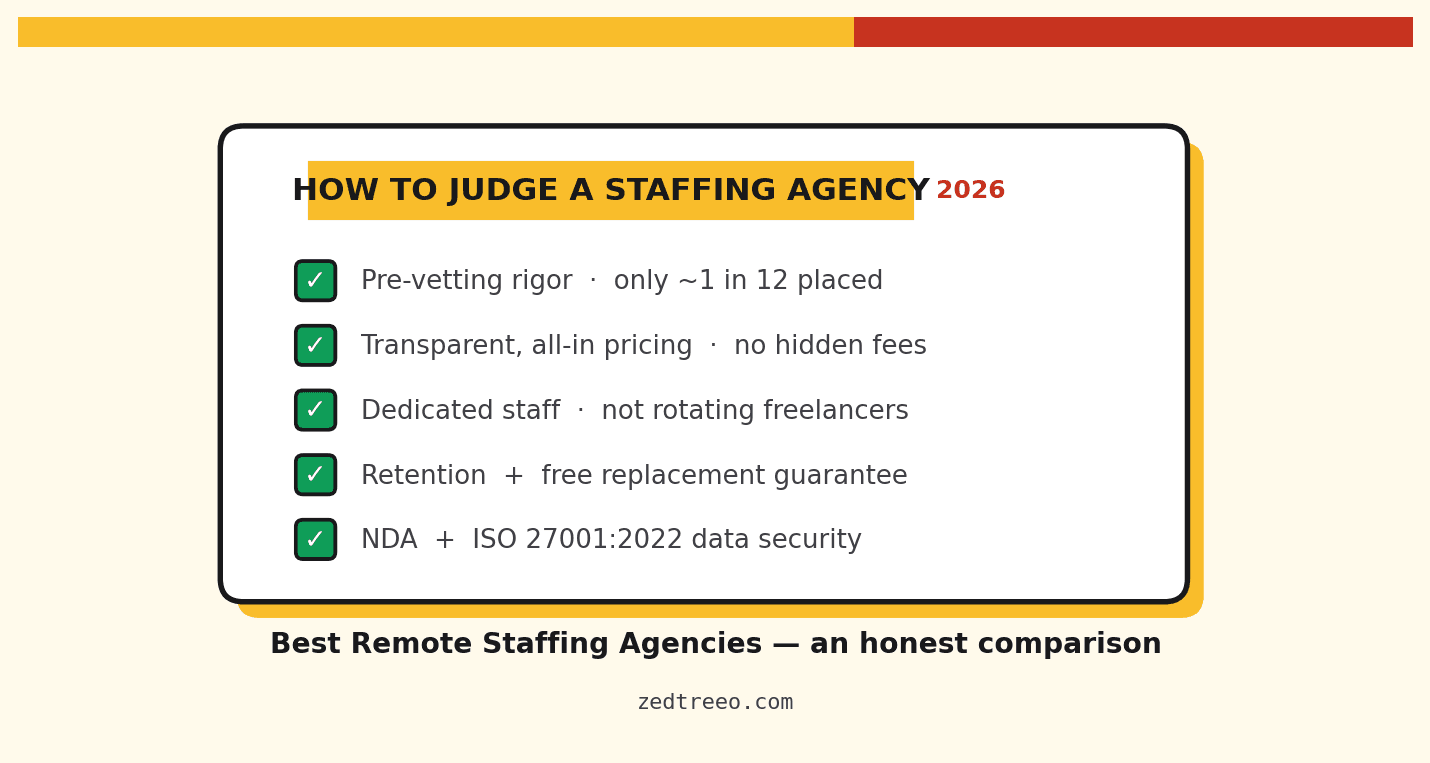
The best remote staffing agencies publish their pricing — or at minimum give you clear ranges without requiring a sales call. There are three dominant pricing models in 2026: hourly rates (most common for dedicated staff), monthly flat fees (popular with EOR platforms), and salary markups of 15–25% (traditional recruitment model). If an agency won't tell you their pricing model before a discovery call, that's a red flag. You can review detailed outsourcing cost benchmarks to set your expectations before evaluating any provider.
Vetting Quality and Talent Pool Depth
An agency is only as good as the people it places. The best providers run multi-stage vetting: resume screening, technical assessments, English proficiency checks, cultural fit interviews, and reference verification. Ask how many candidates are in their active pool, what percentage pass screening, and how they test for role-specific skills. A 3–5% acceptance rate after screening signals a high-quality talent pool. Agencies with shallow vetting processes will cost you more in failed hires and wasted onboarding than any savings on fees.
Speed to Hire and Onboarding Support
The average time to present pre-vetted candidates should be 48 hours to 7 business days. If an agency needs more than two weeks to send you profiles, their pool likely isn't pre-vetted — they're recruiting from scratch on your dime. Beyond placement speed, evaluate the onboarding support: does the agency help with tool setup, communication protocols, time zone scheduling, and the first 30 days of integration? The first month determines whether a remote hire sticks.
Compliance, Payroll, and Legal Coverage
If you're hiring across borders, compliance matters. Some agencies operate as Employers of Record (EOR), handling payroll, tax withholding, benefits, and labor law compliance. Others act as recruitment intermediaries and leave compliance to you. For small and mid-sized businesses without in-house legal teams, EOR coverage or agency-managed payroll can eliminate significant risk — but it comes at a premium ($500–700/month per employee on top of salary). Know what you're getting before you sign.
The 12 Best Remote Staffing Agencies in 2026 (Ranked)
Each agency below is evaluated on the same criteria: pricing transparency, talent quality, speed, compliance, and trial terms. We've noted strengths and weaknesses for every provider — including our own.
1. Zedtreeo — Best for Affordable Dedicated Remote Staff
Starting price: $6/hour ($1,056/month) | Talent region: India | Free trial: Yes
Zedtreeo provides dedicated remote employees from India to businesses globally. The model is straightforward: you describe the role, Zedtreeo matches you with pre-vetted candidates within 48–72 hours, and you get a free trial period before committing. Roles span virtual assistants, bookkeepers, digital marketers, software developers, customer support, legal staff, and healthcare operations.
Pricing is tiered: non-skilled roles start at $6/hour, mid-skill roles (bookkeepers, marketers, designers) at $7–8/hour, and technical roles (developers, DevOps, cybersecurity) at $9–10/hour. Monthly costs range from $800 to $1,600 depending on role complexity — a fraction of US or European equivalents. Learn more about virtual assistant pricing across different providers.
Strengths: Most transparent pricing on this list. Free trial before commitment. Full-time dedicated employees (not shared). Fast candidate matching (48–72 hours). Covers 28+ role categories including niche specializations like probate, RCM, and real estate.
Weaknesses: India-based talent only (if you specifically need LatAm or Eastern European time zones, you'll need a different provider). Less suited for one-off project work — the model is built for ongoing dedicated roles.
2. Toptal — Best for Elite Freelance Specialists
Starting price: $60–150+/hour | Talent region: Global | Trial: 2-week risk-free
Toptal claims a top 3% acceptance rate and delivers freelance specialists in software development, design, finance, and project management. Their vetting process is the most rigorous in the industry: language screening, technical assessment, live coding or portfolio review, and a test project. You get access to elite talent — but at elite prices.
Strengths: Exceptional vetting quality. 2-week risk-free trial. Fast matching for senior-level roles. Strong in development, design, and finance.
Weaknesses: Premium pricing excludes most SMBs. No EOR or payroll services. Freelance model (not full-time dedicated employees). Limited back-office, admin, or support roles.
3. Near — Best for LatAm Talent in US Time Zones
Starting price: ~$2,000/month | Talent region: Latin America | Trial: Varies by role
Near specializes in connecting US companies with remote talent from Latin America. Their key selling point is time zone alignment — LatAm hires typically overlap 6–8 hours with US business hours. Near handles sourcing, screening, and presents qualified candidates within 5–7 business days. No upfront costs; you pay placement or monthly fees after hiring.
Strengths: Excellent US time zone overlap. No upfront fees. Good screening for professional and technical roles. Strong in marketing, operations, and engineering.
Weaknesses: Higher pricing than Asia-based options (LatAm talent costs 2–3x more than India for equivalent skill levels). Limited to Latin American talent pool. No EOR services included.
4. Andela — Best for Senior Engineers and AI Talent
Starting price: Custom | Talent region: Africa, Latin America, Global | Trial: No
Andela built its reputation placing pre-vetted senior engineers, data scientists, and AI specialists from Africa's emerging tech hubs. Their AI-powered Talent Cloud platform matches candidates to roles based on technical assessments, behavioral data, and project history. If you need a senior full-stack developer or machine learning engineer, Andela's pool is deep in those niches.
Strengths: Strong in senior engineering and AI/ML roles. AI-driven matching platform. Growing LatAm talent pool adds geographic diversity. Good cultural vetting process.
Weaknesses: No published pricing — custom quotes only. Not cost-effective for junior or non-technical roles. No EOR or payroll services. Longer onboarding timelines for specialized roles.
5. Remote — Best for Global EOR and Compliance
Starting price: $699/month EOR; $29/month payroll | Region: 180+ countries | Trial: No
Remote.com is an Employer of Record (EOR) platform that handles payroll, benefits, tax compliance, and labor law across 180+ countries. It's not a traditional staffing agency — Remote doesn't source candidates for you. Instead, it's the compliance and payroll infrastructure you use after you've found your hire. If you already know who you want to employ internationally, Remote handles the legal complexity.
Strengths: Best-in-class global compliance coverage. Transparent pricing. Handles benefits, equity, and contractor payments. Strong IP protection framework.
Weaknesses: Not a talent sourcing platform — you bring your own candidates. $699/month per employee adds up for larger teams. No vetting, screening, or matching services.
6. Deel — Best for Contractor and Payroll Management
Starting price: $599/month EOR; $5/month contractor management | Region: 150+ countries | Trial: No
Deel offers a comprehensive platform for hiring contractors and full-time employees globally. Their $5/month contractor management plan is the cheapest in the market for handling invoicing, payments, and compliance for international freelancers. The EOR product at $599/month is competitively priced for full-time international hires. Deel has added some recruitment features, but the core value is payroll and compliance infrastructure.
Strengths: Cheapest contractor management ($5/month). Good UI and automation for payments. Strong compliance in 150+ countries. Integrated with many HRIS tools.
Weaknesses: Recruitment capabilities are limited — primarily a payroll platform. EOR pricing can spike with benefits and add-ons. Customer support quality varies based on plan tier.
7. Outsourced.ph — Best for Philippines-Based Support Teams
Starting price: ~$8/hour | Talent region: Philippines | Trial: Varies
Outsourced.ph is a well-established Philippines-based staffing company serving SMEs that need customer support, virtual assistance, IT helpdesk, and admin operations. The Philippines' strong English proficiency and cultural familiarity with Western business practices make it a reliable option for client-facing roles. Pricing is moderate — higher than India but lower than LatAm.
Strengths: Strong English proficiency among candidates. Good for customer support and admin roles. Established track record with SMEs. Office-based options available for supervised teams.
Weaknesses: Limited technical talent depth compared to India. Pricing is 40–60% higher than India-based equivalents for similar roles. Time zone can be challenging for US companies (12–14 hours ahead).
8. DistantJob — Best for Long-Term Remote Developer Placements
Starting price: Custom (service fee + salary) | Talent region: Global | Trial: No
DistantJob specializes in placing full-time remote developers with a focus on cultural fit and long-term retention. Unlike most agencies, they emphasize integration into your existing team culture — not just technical skills. Their process takes longer (2–4 weeks typical) but aims for hires that stay for years, not months.
Strengths: Strong cultural fit assessment. Focus on long-term retention. Global talent sourcing for dev roles. Good for companies that want remote developers embedded in their team.
Weaknesses: No published pricing. Longer hiring timelines than pre-vetted pool models. Developer-focused only — no support for non-technical roles. No EOR services.
9. BairesDev — Best for Large-Scale Tech Teams
Starting price: ~$50/hour | Talent region: Latin America | Trial: No
BairesDev is one of the largest LatAm tech staffing companies, placing software engineers, QA testers, project managers, and designers. They're built for scale — if you need a team of 10+ developers ramped up within weeks, BairesDev has the pipeline. They claim to vet the top 1% of LatAm tech talent.
Strengths: Can scale teams quickly (10+ people). Deep LatAm developer pool. Project-based and staff augmentation models available. Strong in software development and QA.
Weaknesses: Premium pricing for LatAm market. Quality consistency concerns at scale (some reviews note uneven experiences). Tech-only — no support for business operations or admin roles. No EOR services.
10. Belay — Best for Executive Virtual Assistants
Starting price: ~$2,200/month | Talent region: US-based | Trial: No
Belay provides US-based virtual assistants, bookkeepers, and social media managers — positioned as premium support for executives, entrepreneurs, and busy professionals. If you specifically need a US-based assistant who understands American business culture natively, Belay delivers. But you're paying US rates for it.
Strengths: US-based talent with zero language or cultural barriers. Strong for executive and C-suite support. Good for bookkeeping and social media management. High-touch client experience.
Weaknesses: Significantly more expensive than offshore alternatives (4–5x the cost of India-based VAs). US-only talent pool. Limited role variety — primarily VAs, bookkeepers, and social media. No tech talent.
11. Pearl Talent — Best for Operations and Admin Roles
Starting price: $3,000/month | Talent region: Philippines, Latin America | Trial: No
Pearl Talent focuses on placing operations, admin, and executive support talent from the Philippines and Latin America. Their positioning emphasizes "hidden gem" candidates — people with strong skills who haven't been discovered by the bigger agencies. It's mid-range in pricing and works well for businesses that need reliable operational support without enterprise-scale budgets.
Strengths: Good for operations and admin roles. Vetted talent from Philippines and LatAm. Client testimonials emphasize reliability. Growing platform with expanding role types.
Weaknesses: $3,000/month starting price is high for non-technical roles. Limited engineering and development talent. No EOR or compliance services included. Smaller talent pool than more established competitors.
12. Wing — Best for Subscription-Based VA Services
Starting price: $699/month | Talent region: Philippines, Latin America | Trial: No
Wing operates a subscription model: pay a monthly fee and get a dedicated virtual assistant for tasks like admin support, research, scheduling, inbox management, and light bookkeeping. It's the most accessible entry point on this list for solopreneurs and small teams who need help but don't want to manage a formal hiring process.
Strengths: Simple subscription pricing. Low commitment (month-to-month). Good for task-based support. Managed quality — Wing handles replacements if the VA isn't a fit.
Weaknesses: Not truly dedicated (VAs may handle multiple clients). Limited to basic admin and support tasks. Not suitable for specialized or technical work. Less control over VA selection compared to agency models.
How to Choose the Right Remote Staffing Agency for Your Business
With 12 viable options, the right choice depends on your specific situation. Use this decision framework to narrow the list to 2–3 finalists.
Match the Agency to Your Role Type
Different agencies dominate different role categories. If you need a virtual assistant or bookkeeper, Zedtreeo ($6–8/hr from India) or Wing ($699/mo subscription) are your best-value options. For senior software developers, consider Toptal (elite but expensive) or Andela (strong in engineering). For customer support teams, Outsourced.ph's Philippines-based talent excels. Don't choose a generalist when a specialist exists for your role.
Compare Total Cost of Ownership
Hourly rate isn't the full picture. Factor in: agency management fees, EOR costs (if applicable), onboarding time, replacement costs for failed hires, and productivity ramp-up. A $6/hour dedicated employee from India who stays 2+ years costs far less total than a $25/hour LatAm hire who churns after 6 months. Always compare annualized total cost, not just the headline rate.
Evaluate Trial and Exit Terms
Agencies that offer free trials demonstrate confidence in their talent quality. Month-to-month contracts are standard and preferred — avoid agencies that lock you into 6–12 month minimums before you've validated the hire. Ask about replacement guarantees: what happens if a hire doesn't work out within the first 30, 60, or 90 days?
Check Compliance Coverage for Your Market
If your hire will be a full-time employee (not a contractor), you need either an EOR service (Deel, Remote) or an agency that handles employment compliance in the talent's country. If the agency classifies workers as contractors, verify that the classification is legally valid in both jurisdictions to avoid misclassification penalties.
Remote Staffing Costs: What You'll Actually Pay in 2026
This is the section most "best staffing agencies" articles skip. Here's what remote hires actually cost by region and role — based on market data, not estimates.
Pricing by Region
| Region | VA / Admin | Bookkeeper | Developer | Digital Marketer |
|---|---|---|---|---|
| India | $6/hr | $7–8/hr | $9–15/hr | $7–10/hr |
| Philippines | $6–8/hr | $8–10/hr | $12–20/hr | $8–12/hr |
| Latin America | $12–18/hr | $15–22/hr | $25–50/hr | $15–25/hr |
| Eastern Europe | $15–20/hr | $18–25/hr | $30–55/hr | $18–30/hr |
| US-based | $25–40/hr | $30–50/hr | $75–150/hr | $40–75/hr |
Source: Aggregated from agency published rates, Glassdoor, PayScale, and Zedtreeo internal placement data (2026).
Hidden Costs to Watch For
Beyond the headline rate, factor in these costs that agencies may not mention upfront: setup or onboarding fees ($200–500 one-time), management or platform fees (5–20% of salary), replacement fees if a hire doesn't work out, equipment and software provisioning, and currency conversion or payment processing charges. The most transparent agencies — like Zedtreeo — bundle these into their hourly rate so you know exactly what you'll pay monthly.
Why Pay More? Hire Dedicated Remote Staff from $6/Hour
Zedtreeo provides pre-vetted employees globally across 28+ role categories. Free trial. No long-term contracts. Get matched in 48 hours.
Get Your Free Shortlist →Best Remote Staffing Agencies by Role
Instead of guessing which agency fits your needs, use this role-based shortlist to narrow your search instantly.
| Role Category | Best Agency | Starting Rate | Runner-Up |
|---|---|---|---|
| Virtual Assistants | Zedtreeo | $6/hr | Wing ($699/mo) |
| Software Developers | Toptal | $60/hr | Zedtreeo ($9/hr) / Andela |
| Accounting & Bookkeeping | Zedtreeo | $7/hr | Belay ($2,200/mo) |
| Digital Marketing | Zedtreeo | $7/hr | Near (~$2,000/mo) |
| Customer Support | Outsourced.ph | $8/hr | Zedtreeo ($6/hr) |
| Global Payroll & EOR | Deel | $599/mo | Remote ($699/mo) |
The pattern to act on: pick by role, not by brand. Toptal's $60/hr developers make sense for a short senior engagement, but a comparable dedicated developer at $9/hr costs roughly 85% less on a full-time basis — the same math that puts $6/hr virtual assistants ahead of Wing's $699/mo plans. And if you only need payroll compliance, Deel's $599/mo EOR is the right tool, not a staffing agency. Match the starting-rate column to how long you'll need the role, not to whoever advertises loudest.
Common Mistakes When Hiring Through a Remote Staffing Agency
Knowing what to avoid is as important as knowing what to look for. These are the mistakes that cost businesses the most time and money.
Choosing based on hourly rate alone. The cheapest option isn't always the most cost-effective. A $6/hour hire with proper vetting and a free trial (like Zedtreeo offers) can deliver more ROI than a $15/hour hire from an agency with poor screening that churns after 3 months. Compare total cost of ownership over 12 months, including replacement costs.
Ignoring time zone overlap. If your remote employee needs to attend daily standups with a US team, an India-based hire (10–12 hour difference) requires different management than a LatAm hire (1–3 hour difference). Neither is inherently better — but you need to design your workflow around the time gap. Agencies like Zedtreeo provide candidates experienced in async communication and flexible scheduling.
Skipping the trial period. Never commit to a 6-month contract without testing the relationship first. The best agencies offer free trials or short paid pilots. If an agency won't let you test before committing, question why they're not confident in their own talent quality.
Not defining the role clearly before engaging. Vague job descriptions produce vague candidates. Before contacting any agency, document: specific tasks and responsibilities, required tools and software proficiency, working hours and communication expectations, and measurable KPIs for the first 90 days.
Confusing staffing agencies with freelance platforms. A staffing agency provides dedicated employees who work full-time for your business. Freelance platforms (Upwork, Fiverr) provide project-based workers who juggle multiple clients. If you need someone for 40 hours/week, ongoing — go with a staffing agency. For one-off projects under 20 hours, a freelance platform may suffice. Understanding this distinction can save you from applying the wrong solution to your hiring challenge. For a deeper comparison of AI automation versus traditional outsourcing, see our detailed analysis.
Frequently Asked Questions
What is the best remote staffing agency?
The best remote staffing agency depends on your budget, role type, and preferred talent region. For affordable dedicated staff from India starting from $6/hour, Zedtreeo is a top choice. For elite freelancers, Toptal leads. For Latin American talent in US time zones, Near excels. Evaluate agencies on pricing transparency, vetting quality, trial options, and compliance coverage.
How much do remote staffing agencies charge?
Remote staffing agency pricing varies by model and region. India-based agencies like Zedtreeo start from $6/hour ($1,056/month). LatAm agencies range $10–25/hour. Premium platforms like Toptal charge $60–150+/hour. Most agencies use hourly rates, monthly flat fees, or salary markups (15–25%). Always compare total cost of ownership, not just the headline rate.
Is it cheaper to hire remote staff from India or Latin America?
India is typically 40–60% cheaper than Latin America for equivalent roles. A skilled virtual assistant from India costs $6–8/hour versus $12–20/hour from LatAm. Software developers from India range $9–15/hour versus $25–50/hour from LatAm. India offers the largest English-speaking talent pool and deep specialization in IT, accounting, and back-office operations.
What should I look for in a remote staffing agency?
Prioritize five factors: pricing transparency (ask for all-in rates), vetting rigor (skills testing, background checks, interviews), compliance coverage (payroll and labor law), trial periods (risk-free engagement before committing), and replacement guarantees (what happens if a hire doesn't work out). Avoid agencies that won't disclose rates upfront.
How long does it take to hire through a remote staffing agency?
Most remote staffing agencies deliver pre-vetted candidates within 5–14 business days. Agencies with existing talent pools like Zedtreeo present shortlisted candidates in 48–72 hours. Full onboarding typically takes 1–2 weeks after selection. Agencies handling EOR setup may need 2–4 weeks for international compliance paperwork.
Are remote staffing agencies better than freelance platforms?
Remote staffing agencies provide dedicated full-time employees with vetting, compliance, and management support — ideal for ongoing roles. Freelance platforms like Upwork suit short-term project work but offer less oversight, no replacement guarantees, and higher turnover. For roles requiring 20+ hours/week with long-term commitment, staffing agencies deliver better ROI.
Can a small business afford a remote staffing agency?
Yes. India-based remote staffing agencies like Zedtreeo start from $6/hour ($1,056/month) for skilled roles including virtual assistants, bookkeepers, and marketers. This is 60–80% less than US hiring costs. Many agencies offer month-to-month contracts with no long-term commitments, making remote staffing accessible for businesses with budgets as low as $1,000/month.
What roles can you hire through a remote staffing agency?
Remote staffing agencies cover virtually every business function: virtual assistants, software developers, accountants, bookkeepers, digital marketers, customer support, DevOps engineers, designers, legal assistants, healthcare support (RCM, medical billing), project managers, and data entry specialists. Specialized agencies focus on verticals like IT, finance, or healthcare.
Final Verdict — Which Remote Staffing Agency Should You Choose?
There's no single "best" agency for everyone, but there is a best agency for your specific situation. Here's the decision simplified:
If you want the lowest cost with the widest role coverage: Zedtreeo. Starting from $6/hour with 28+ role categories, a free trial, and month-to-month contracts — it's the highest ROI option for SMBs that need dedicated remote staff without breaking the budget.
If you need a senior developer and budget isn't a constraint: Toptal. Their vetting is the gold standard for elite technical talent, and the 2-week trial protects your investment.
If US time zone overlap is non-negotiable: Near (LatAm talent) or Belay (US-based talent at premium pricing).
If you need EOR and global payroll infrastructure: Deel (cheapest) or Remote (most comprehensive coverage).
If you need to scale a tech team fast: BairesDev for LatAm; Zedtreeo for India-based developers at a fraction of the cost.
Whatever you choose, prioritize agencies that show you real pricing, let you trial before committing, and offer replacement guarantees. The best remote staffing relationship is one where both sides have skin in the game.
Ready to Hire? Get Matched with Pre-Vetted Remote Talent in 48 Hours
Zedtreeo provides dedicated remote employees globally starting from $6/hour. Free trial before you commit. No long-term contracts. 28+ role categories.
Start Your Free Trial →