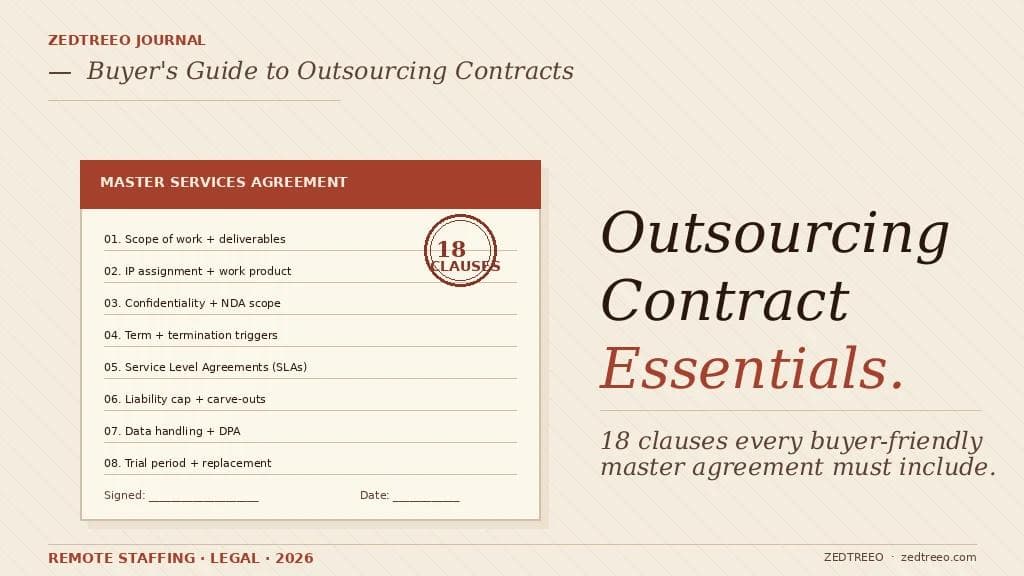
Outsourcing contracts are where most buyer-vendor relationships break — long after the kickoff call, the first invoice, and the seemingly aligned scope conversation. We have placed over 500 dedicated remote professionals across 200+ client engagements, and the single most common pattern in disputes is not bad work or missed deadlines. It is contract gaps. Buyers anchor on hourly rate and skip the 18 clauses that determine what happens when reality diverges from the original assumption.
This guide breaks down every clause you should require, why it matters, the buyer-friendly version of the language, and the failure mode when it is missing. It is written for executives and operations leaders who sign outsourcing agreements but are not lawyers — the goal is decision-grade clarity, not legalese. Pair this with our free Contract Checklist tool to score any contract you are about to sign.
Featured Snippet Definition: An outsourcing contract is a legally binding agreement between a buyer and a service provider that defines scope of work, deliverables, payment terms, intellectual property ownership, confidentiality, service-level commitments, termination rights, and liability allocation. The 18 clauses every outsourcing contract must include are: scope of work, deliverables and acceptance, fees and payment, term and renewal, termination for cause and convenience, IP ownership, confidentiality and NDA, data protection and privacy, security controls, sub-contracting and assignment, SLAs and performance metrics, change control, warranties, indemnification, limitation of liability, governing law and dispute resolution, force majeure, and survival clauses. Missing any of these creates exposure that, on average, costs buyers between $25,000 and $250,000 per dispute according to industry arbitration data.
Founders, ops leads, and in-house counsel reviewing (or about to sign) an outsourcing or remote-staffing agreement — the 18 clauses that decide who carries the risk, in plain English, with buyer-friendly versions of each.
How we sourced this
Clause guidance distills standard contract practice for offshore staffing engagements and Zedtreeo's own client-agreement structure (LegelpTech Outsourcing Pvt Ltd, ISO 27001:2022 certified). This is practical guidance, not legal advice — have counsel review your specific agreement. Last reviewed July 2026.
Why Most Outsourcing Contracts Fail
In our review of contract disputes across the offshore staffing and managed-services markets, three failure modes show up repeatedly. The first is template inertia: buyers paste a 2018-era SaaS agreement onto a 2026 staff-augmentation engagement and never reconcile the mismatch — IP language designed for software licensing does not protect work product produced by a dedicated developer. The second is asymmetric risk: vendors propose contracts that cap their liability at one month of fees while the buyer's downside on a failed deliverable is six figures. The third is enforcement geography: buyers sign agreements governed by jurisdictions where they cannot realistically enforce a judgment.
The good news is that all three are avoidable with the right clause structure. Below is the blueprint.
The 18 Clauses Every Outsourcing Contract Must Include
1. Scope of Work (SoW)
The scope clause defines what the vendor will and will not do. It should be written as a hierarchical list — primary deliverables, supporting activities, explicit exclusions — not a paragraph. We recommend separating ongoing operational work from project-specific deliverables in distinct sections, because the renewal and termination logic is different for each. A vague SoW is the root cause of approximately 60% of vendor disputes; a precise SoW prevents most scope creep before it starts.
2. Deliverables and Acceptance Criteria
For every deliverable, define the format, the acceptance test, who tests it, and how long the buyer has to accept or reject. The default acceptance window should be 10 to 15 business days. Without this clause, vendors can claim deliverables are "accepted by silence" after as little as 48 hours. Always require written acceptance, never implied acceptance.
3. Fees and Payment Terms
Spell out the rate structure, payment frequency, currency, accepted payment methods, late-payment terms, and any inflators. Fixed monthly, hourly with a cap, milestone-based, and time-and-materials are the four main pricing models — each one carries different risk. Our default at Zedtreeo is monthly retainer billing on a dedicated employee model, starting from $6/hour ($1,056/month full-time), which gives buyers predictable cash flow and removes scope-disputed billing entirely. Avoid contracts that allow rate increases mid-term without buyer consent.
4. Term and Renewal
Define the initial term, the renewal mechanism, and the notice period required to opt out. Auto-renewal clauses without sufficient notice (under 30 days) can trap buyers in another full term against their will. Insist on at minimum a 30-day, ideally 60-day, opt-out window. For trial-based engagements, ensure the trial language complies with the FTC Negative Option Rule — see our free trial terms for an example of what a compliant trial disclosure looks like.
5. Termination for Cause and Convenience
This is the single most negotiated clause and often the most asymmetric. Termination for cause should include material breach, repeated failure to meet SLAs (usually three consecutive months), insolvency, change of control, and breach of confidentiality. Termination for convenience — the right to exit without cause — is a buyer-side power lever. Insist on at least 30-day termination for convenience with no early-exit penalty for engagements over six months.
6. Intellectual Property Ownership
IP is where outsourcing contracts most often favor the vendor's interests over the buyer's. The core principle: all work product created during the engagement should be a "work made for hire" that vests in the buyer immediately upon creation, with a backup assignment clause for any jurisdiction where work-for-hire doctrine does not apply. Pre-existing IP brought by either party stays with that party. Vendor's general tools, libraries, and methodologies should be licensed back to the buyer on a perpetual, royalty-free basis to avoid lock-in. Do not accept any clause that gives the vendor a license to your data or work product for "improvement of services."
7. Confidentiality and NDA
Confidentiality should run the length of the engagement plus three to five years post-termination, depending on the sensitivity of the information. Define what counts as confidential information broadly — including all materials, communications, and information disclosed in any form. Carve out clear exceptions: information already public, independently developed, or required by law. Always require return or destruction of confidential information within 30 days of termination, with written certification.
8. Data Protection and Privacy
If your business handles any personal data, this clause is essential. Reference applicable regimes — GDPR for EU subjects, CCPA and the seven other US state privacy laws, UK GDPR, PIPEDA in Canada, DPDP in India, and any sectoral regulations like HIPAA. Require a Data Processing Addendum that defines roles, transfer mechanisms (Standard Contractual Clauses for EU transfers), and breach-notification timelines. Zedtreeo runs on GDPR-aligned infrastructure with documented Standard Contractual Clauses for EU buyers — see our privacy policy for the practitioner-grade framework we apply.
9. Security Controls
Specify minimum security baselines: device encryption, two-factor authentication, role-based access, principle of least privilege, secure development practices for engineering work, and an annual security audit. For sensitive industries (healthcare, financial services, government-adjacent), reference industry standards like ISO 27001-aligned controls or SOC 2 Type II-aligned operating procedures. Require a written incident-response plan with defined notification windows — typically 72 hours for confirmed breaches, in line with GDPR Article 33.
10. Sub-Contracting and Assignment
Vendors should not be able to silently sub-contract sensitive work to unknown third parties. Require written buyer consent for any sub-contractor with access to confidential information. Assignment of the contract itself should be restricted to a change of control of the vendor, and even then the buyer should retain a termination right if the acquirer is a competitor. We have seen multiple buyers caught off guard when a small vendor was acquired by a competitor mid-contract.
11. Service-Level Agreements (SLAs) and Performance Metrics
SLAs are the contractual measurement of vendor performance. The four most important categories are availability (uptime for managed services), responsiveness (time to acknowledge and resolve), throughput (deliverables per period), and quality (defect rates, accuracy thresholds). Each SLA should have a target, a measurement method, a measurement window, and a financial credit for missed targets. Service credits should escalate with repeated misses — for example, 5% of monthly fees for one missed SLA in a quarter, 15% for two, 30% for three, plus a termination right for the third.
12. Change Control
Scope changes are inevitable. Without a change-control clause, every change is a renegotiation. The clause should require a written change order that documents the change, its impact on fees and timeline, and a sign-off from authorized representatives on both sides. Define who is authorized — typically a single named person on each side. Verbal approvals should be explicitly excluded as binding.
13. Warranties
The vendor should warrant that the work product is original (not infringing third-party IP), conforms to the agreed specifications, and is free of malicious code. The buyer should warrant authority to enter the contract and ownership of any materials provided to the vendor. Warranties typically run 90 days from delivery for project work and continuously for ongoing managed services.
14. Indemnification
The vendor should indemnify the buyer against third-party claims arising from the vendor's IP infringement, breach of confidentiality, security breaches caused by vendor negligence, and any willful misconduct. Mutual indemnification (the buyer also indemnifies the vendor for buyer-provided materials) is standard and reasonable. The indemnity should include defense costs, not just final judgments — defense alone can run six figures even if the claim ultimately fails.
15. Limitation of Liability
This is the second most negotiated clause. Vendors typically propose caps at one to three months of fees; that cap is far too low for any meaningful engagement. Aim for a cap equal to 12 months of fees, with carve-outs for IP infringement, confidentiality breaches, gross negligence, willful misconduct, and indemnity obligations — those should be uncapped. Consequential damages (lost profits, business interruption) are typically excluded on both sides; that exclusion is industry standard but should explicitly preserve direct damages.
16. Governing Law and Dispute Resolution
Choose a jurisdiction where you can realistically enforce a judgment. For US buyers contracting with India-based vendors, most experienced counsel recommend governing the contract under the buyer's home state law, with disputes resolved by arbitration under the rules of a neutral institution (ICC, JAMS, or AAA International). Specify the seat of arbitration in the buyer's home country. For staffing engagements where day-to-day issues are operational rather than legal, we recommend a tiered escalation: 30 days of good-faith negotiation, then mediation, then arbitration as the last resort.
17. Force Majeure
Force majeure clauses received unprecedented attention after 2020. The clause should cover acts of God, war, civil unrest, government actions, pandemics, and "other events beyond reasonable control." Importantly, the clause should require the affected party to provide written notice within a defined period (5 to 10 business days) and include a termination right for the unaffected party if the force majeure event continues beyond 30 to 90 days. Do not accept clauses that allow vendors to declare force majeure for ordinary business issues like staffing shortages.
18. Survival Clauses
Several clauses must survive termination to function — confidentiality, IP assignment, indemnification, limitation of liability, governing law, dispute resolution, and any payment obligations for services already delivered. The survival clause should explicitly list which clauses survive and for how long. Without explicit survival language, courts in some jurisdictions interpret silence as termination of all obligations, which exposes you on confidentiality and IP after the contract ends.
Comparison: Zedtreeo Contract vs Common Outsourcing Models
| Contract Element | Freelance Marketplace (Upwork-style) | Premium Freelance Network | Traditional BPO | Zedtreeo Dedicated Staffing |
|---|---|---|---|---|
| IP ownership | Marketplace TOS — varies | Network-mediated | Master agreement, often vendor-favorable | Buyer owns all work product, work-for-hire + assignment |
| Trial period | Hourly only — milestone refund disputes | Limited — typically 1 week paid | No trial — long-term commitment | 5 days, no card on file, full replacement option |
| Termination notice | Project-by-project | 7 to 14 days | 30 to 180 days | 30 days, no early-exit fee |
| SLA structure | None — pay-per-output | Soft SLA via reputation | Hard SLA with credits | Hard SLA + monthly performance reviews + replacement at no cost |
| Liability cap | Marketplace cap — typically nominal | Project fee multiplier | 3-month fees typical | 12-month fees, IP/confidentiality/gross negligence uncapped |
| Governing law | Marketplace HQ jurisdiction | Network-defined | Vendor's home jurisdiction (often) | Buyer's home state, neutral arbitration seat |
| Pricing model | Hourly per task, marketplace fees added | Hourly with curation premium | Fixed monthly project | Starting from $6/hour, monthly retainer ($1,056/month full-time) |
The termination column is where the real risk lives: a traditional BPO can lock you into 30 to 180 days of notice, while a marketplace hire can vanish project-by-project with no obligation at all. Push for the middle ground — a dedicated staffing agreement with 30-day notice, no early-exit fee, and a genuine trial (Zedtreeo's is 5 days with no card on file). If a vendor can't match at least two of those terms, keep negotiating.
Anonymized Client Examples
Case 1: SaaS Startup, 22-person team, US-based
The buyer signed a master services agreement with a previous offshore vendor that capped liability at one month of fees ($4,800) and gave the vendor a license to "use anonymized data for product improvement." Eighteen months in, the vendor was acquired by a direct competitor of the buyer. Because the contract had no change-of-control termination right and the data license survived termination, the buyer faced a $40,000 legal review to determine whether the acquirer could continue accessing prior work product. After migrating to Zedtreeo's dedicated staffing model, the buyer's new contract included full IP assignment, a change-of-control termination right with no early-exit penalty, and a 12-month liability cap with uncapped IP and confidentiality carve-outs.
Case 2: Healthcare Analytics Firm, 60-person team, multi-region
The buyer required HIPAA-aligned operating practices for a billing-data engagement. Their previous contract referenced HIPAA only by name and provided no Business Associate Agreement, no breach-notification window, and no data-handling SOPs. After two minor security events that the vendor failed to disclose for 11 days each, the buyer rebuilt the contract with explicit Business Associate Agreement terms, 72-hour breach notification, named security-officer responsibilities, and quarterly security reviews. We now operate this engagement under our HIPAA-aligned operational practices with full boundary-of-responsibility documentation. The buyer reported zero incidents in the following 14 months and reduced their compliance audit time by 38%.
Liability Cap: What to Ask For vs What Vendors Propose
| Engagement Size (Annual Spend) | Vendor Default Proposal | Buyer-Friendly Target | Carve-Outs (Always Uncapped) |
|---|---|---|---|
| Under $50K | 1 month fees | 12 months fees | IP, confidentiality, gross negligence |
| $50K to $250K | 3 months fees | 12 months fees | IP, confidentiality, gross negligence, willful misconduct |
| $250K to $1M | 6 months fees | 12 months fees + indemnity uncapped | All of above + indemnity obligations |
| Over $1M | 12 months fees | 2x annual fees + multiple uncapped categories | All of above + data breach + regulatory fines |
Notice the gap on smaller engagements: vendors routinely propose a cap of just 1 month of fees on sub-$50K deals — meaning a botched project could cost you far more than you could ever recover. Counter with 12 months of fees as your floor at every tier, and never let IP, confidentiality, or gross negligence sit inside the cap. On engagements over $1M, push for 2x annual fees plus uncapped data-breach liability.
How to Use This in Your Next Contract Review
Print or open our free Contract Checklist tool and score the contract you are about to sign against all 18 clauses. Any score below 14 of 18 indicates material exposure. For clauses that are missing or weak, the most efficient negotiation path is to redline the vendor's draft with specific replacement language rather than asking for "stronger language" in the abstract. Vendors will accept specific redlines they can review legally; vague asks often stall.
If you would rather avoid the negotiation cycle entirely, our team offers a contract review service for new and existing engagements. Reach out via our contact page with the draft you want reviewed.
Get a Pre-Negotiated, Buyer-Friendly Outsourcing Contract
Zedtreeo client engagements use a buyer-friendly master agreement built on the 18 clauses above — full IP assignment, 30-day termination, hard SLAs with replacement at no cost, and a 5-day free trial under our published trial terms. Starting from $6/hour for dedicated remote staff.
Related Reading
- Hire dedicated remote employees — our flagship service page
- The five dominant remote staffing models in 2026 — choose the right model before contracting
- Free Cost Calculator — model the all-in cost of your next outsourcing engagement
- Remote Staffing Wiki — independent industry reference covering model selection and contract patterns
- American Bar Association — Business Law Section — primary source for US contract drafting guidance
- GDPR.eu compliance checklist — primary EU privacy reference
Frequently Asked Questions
Can a small business negotiate these 18 clauses, or are they only for enterprise contracts?
All 18 clauses apply regardless of company size. Small buyers often have more leverage than they realize because outsourcing vendors compete heavily for new accounts. Insist on the buyer-friendly version of each clause. If a vendor refuses to negotiate IP, liability cap, or termination — that is a strong signal to look elsewhere. Most reputable providers will accept reasonable redlines without resistance.
What is the typical liability cap in an outsourcing contract?
Vendors typically propose 1 to 3 months of fees as the cap, but that is far too low for any meaningful engagement. Buyers should aim for 12 months of fees as the standard cap, with carve-outs for IP infringement, confidentiality breaches, gross negligence, willful misconduct, and indemnity obligations — those should be uncapped to protect against the highest-impact failure modes.
Should outsourcing contracts use US law or the vendor's home country law?
For US-based buyers, governing law should be the buyer's home state. Disputes should be resolved by arbitration under a neutral institution like ICC, JAMS, or AAA International, with the seat of arbitration in the buyer's home country. This avoids the practical impossibility of enforcing a US judgment in the vendor's jurisdiction while keeping the contract enforceable.
How long should the confidentiality clause survive after termination?
Standard market practice is the engagement term plus three to five years post-termination, depending on data sensitivity. For trade secrets and protected health information, the clause should survive indefinitely. Always require return or written certified destruction of all confidential information within 30 days of termination so there is no ambiguity about what the vendor still holds.
What SLAs are reasonable for a dedicated staffing engagement (versus managed services)?
For dedicated staff, SLAs focus on availability hours, response time, replacement window, and quality metrics tied to the role. Reasonable benchmarks: 4 to 8 hours of overlap with the buyer's working hours, 24-hour response on operational issues, replacement within 7 to 14 days at no cost if a placement is not working out, and quality reviewed monthly. We use this baseline for all 200+ active client engagements at Zedtreeo.
Do I need a Business Associate Agreement when outsourcing healthcare-related work?
Yes. Under HIPAA, any third party that creates, receives, maintains, or transmits Protected Health Information on behalf of a covered entity must sign a Business Associate Agreement. The Business Associate Agreement is separate from the master services agreement and defines responsibilities for safeguarding PHI, breach notification, and termination. See our HIPAA-aligned operational practices page for the framework we apply.
What is the right termination notice for a dedicated staffing contract?
For dedicated staffing engagements over six months, 30 days is the buyer-friendly market standard. Longer notice (60 to 90 days) is common in larger BPO contracts where transition is more complex, but we recommend 30 days for staff augmentation to preserve flexibility. There should be no early-exit fee for termination for convenience after the initial trial period.
How does Zedtreeo handle contract disputes if they arise?
Our master services agreement uses a tiered escalation: 30 days of good-faith negotiation between operational leads first, then escalation to executive sponsors, and only after both stages have been exhausted, formal arbitration under AAA International rules with the seat in the buyer's home country. In 200+ engagements over four years, fewer than 1% have escalated past the negotiation stage — primarily because our contract clarity prevents most disputes upstream.
Final Word
Outsourcing contracts are not commodity templates. The 18 clauses above are the difference between a clean, predictable engagement and an expensive surprise. If you take only one action from this guide, redline your next contract against the 18-point list above before signing — that 30-minute investment frequently saves five to six figures in disputed costs.
For dedicated remote staffing engagements, our team has refined this contract structure across 200+ client relationships. We are happy to share the specific buyer-friendly language we use as a starting point — reach out via the contact page for a tailored brief and shortlist within 48 hours.
By Anita Singh, Content Strategist at Zedtreeo
· Reviewed by Gaurav Gaur, Legal Advisor
· Updated May 30, 2026